Summary

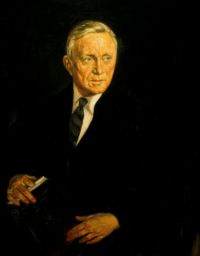
Portrait of William O. Douglas William O. Douglas Clark v. Uebersee Finanz-Korporation…

It is said that the entire property of a corporation would be jeopardized merely because a negligible stock interest, perhaps a single share, was directly or indirectly owned or controlled by an enemy or ally of an enemy. It is also pointed out that securities or interests other than stock might be held by an enemy or ally of an enemy and used effectively in economic warfare against this country.
Source: Wikisource

Portrait of William O. Douglas William O. Douglas Clark v. Uebersee Finanz-Korporation…

It is hard for us to assume that Congress adopted that drastic course in the case of friendly or neutral fireign interests whose investments in our economy were in no way infected with enemy ownership or control. Our hesitation is, moreover, increased when we note that § 7 (c) makes the remedy under the Act the only one Congress has granted a claimant. It is not easy for us to assume that Congress treated all nonenemy nations, including our recent allies, in such a harsh manner, leaving them only with such remedy as they might have under the Fifth Amendment.
Source: Wikisource

Portrait of William O. Douglas William O. Douglas Clark v. Uebersee Finanz-Korporation…

It is pointed out that technical legal title 'to some of the most dangerous of the Axis-influenced enterprises may be Swiss, Dutch, Swedish or American.' It is also said that 'Actual ownership of business enterprises frequently runs through tangled mazes of holding companies. These holding companies were normally incorporated in neutral countries and the ownership of the holding companies themselves was normally represented by bearer shares, making it extremely difficult to negate a claim that the ownership of the corporation was coincident with the state of incorporation.'↑ Sec.
Source: Wikisource

Get perspective with Kwize: daily news enlightened by great literature