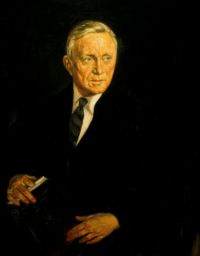
William O. Douglas

William O. Douglas

Summary

Portrait of William O. Douglas William O. Douglas Perez v. Brownell — Dissent

Does the Constitution permit Congress to cancel his citizenship? Could an American who violated his passport restrictions and visited Red China be deprived of his citizenship? Or suppose he trades with those under a ban. To many people any of those acts would seem much more heinous than the fairly innocent act of voting abroad. If casting a ballot abroad is sufficient to deprive an American of his citizenship, why could not like penalties be imposed on the citizen who expresses disagreement with his Nation's foreign policy in any of the ways enumerated?
Source: Wikisource

Portrait of William O. Douglas William O. Douglas Perez v. Brownell — Dissent

Yet if the power to regulate foreign affairs can be used to deprive a person of his citizenship because he voted abroad, why may not it be used to deprive him of his citizenship because his views on foreign policy are unorthodox or because he disputed the position of the Secretary of State or denounced a Resolution of the Congress or the action of the Chief Executive in the field of foreign affairs?
Source: Wikisource

Portrait of William O. Douglas William O. Douglas Perez v. Brownell — Dissent

Citizenship, like freedom of speech, press, and religion, occupies a preferred position in our written Constitution, because it is a grant absolute in terms. The power of Congress to withhold it, modify it, or cancel it does not exist. One who is native-born may be a good citizen or a poor one. Whether his actions be criminal or charitable, he remains a citizen for better of for worse, except and unless he voluntarily relinquishes that status. While Congress can prescribe conditions for voluntary expatriation, Congress cannot turn white to black and make any act an act of expatriation.
Source: Wikisource

Get perspective with Kwize: daily news enlightened by great literature