Summary

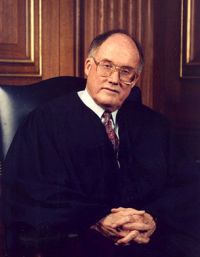
Portrait of William Rehnquist William Rehnquist Estelle v. McGuire — Opinion of the Court

By eliminating the possibility of accident, the evidence regarding battered child syndrome was clearly probative of that essential element, especially in light of the fact that McGuire had claimed prior to trial that Tori had injured herself by falling from the couch. The Court of Appeals, however, ruled that the evidence should have been excluded because McGuire did not raise the defense of accidental death at trial. But the prosecution's burden to prove every element of the crime is not relieved by a defendant's tactical decision not to contest an essential element of the offense.
Source: Wikisource

Portrait of William Rehnquist William Rehnquist Estelle v. McGuire — Opinion of the Court

Nor do our habeas powers allow us to reverse McGuire's conviction based on a belief that the trial judge incorrectly interpreted the California Evidence Code in ruling that the prior injury evidence was admissible as bad acts evidence in this case. See Cal.Evid.Code Ann. § 1101 (b) (West 1988) . The only question for us is "whether the ailing instruction by itself so infected the entire trial that the resulting conviction violates due process."
Source: Wikisource

Portrait of William Rehnquist William Rehnquist Estelle v. McGuire — Opinion of the Court

Furthermore, the trial court guarded against possible misuse of the instruction by specifically advising the jury that the " [prior injury] evidence, if believed, was not received, and may not be considered by you [,] to prove that [McGuire] is a person of bad character or that he has a disposition to commit crimes." See n. 1, supra. Especially in light of this limiting provision, we reject McGuire's claim that the instruction should be viewed as a propensity instruction.
Source: Wikisource

Get perspective with Kwize: daily news enlightened by great literature