Summary

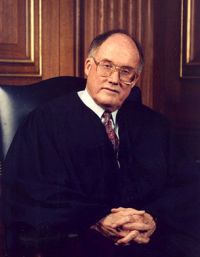
Portrait of William Rehnquist William Rehnquist Payne v. Tennessee — Opinion of the Court

We thus hold that if the State chooses to permit the admission of victim impact evidence and prosecutorial argument on that subject, the Eighth Amendment erects no per se bar. A State may legitimately conclude that evidence about the victim and about the impact of the murder on the victim's family is relevant to the jury's decision as to whether or not the death penalty should be imposed. There is no reason to treat such evidence differently than other relevant evidence is treated.
Source: Wikisource

Portrait of William Rehnquist William Rehnquist Payne v. Tennessee — Opinion of the Court

There is nothing you can do to ease the pain of any of the families involved in this case. There is nothing you can do to ease the pain of Bernice or Carl Payne, and that's a tragedy. There is nothing you can do basically to ease the pain of Mr. and Mrs. Zvolanek, and that's a tragedy. They will have to live with it the rest of their lives. There is obviously nothing you can do for Charisse and Lacie Jo. But there is something that you can do for Nicholas.
Source: Wikisource

Portrait of William Rehnquist William Rehnquist Payne v. Tennessee — Opinion of the Court

We are now of the view that a State may properly conclude that for the jury to assess meaningfully the defendant's moral culpability and blameworthiness, it should have before it at the sentencing phase evidence of the specific harm caused by the defendant. " [T] he State has a legitimate interest in counteracting the mitigating evidence which the defendant is entitled to put in, by reminding the sentencer that just as the murderer should be considered as an individual, so too the victim is an individual whose death represents a unique loss to society and in particular to his family."
Source: Wikisource

Get perspective with Kwize: daily news enlightened by great literature