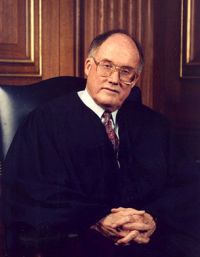
William Rehnquist

William Rehnquist

Summary

Portrait of William Rehnquist William Rehnquist Stone v. Graham — Dissent Rehnquist (1980)

I should suppose it is a proper, if not an indispensable, part of preparation for a worldly life to know the roles that religion and religions have played in the tragic story of mankind. The fact is that, for good or for ill, nearly everything in our culture worth transmitting, everything which gives meaning to life, is saturated with religious influences, derived from paganism, Judaism, Christianity--both Catholic and Protestant--and other faiths accepted by a large part of the world's peoples.
Source: Wikisource

Portrait of William Rehnquist William Rehnquist Stone v. Graham — Dissent Rehnquist (1980)

The fact that the asserted secular purpose may overlap with what some may see as a religious objective does not render it unconstitutional. As this Court stated in McGowan v. Maryland, 366 U.S. 420, 445 (1961) , in upholding the validity of Sunday closing laws, "the present purpose and effect of most of [these laws] is to provide a uniform day of rest for all citizens; the fact that this day is Sunday, a day of particular significance for the dominant Christian sects, does not bar the state from achieving its secular goals."
Source: Wikisource

Portrait of William Rehnquist William Rehnquist Stone v. Graham — Dissent Rehnquist (1980)

The Establishment Clause does not require that the public sector be insulated from all things which may have a religious significance or origin. This Court has recognized that "religion has been closely identified with our history and government," Abington School District, supra, at 212, and that " [t] he history of man is inseparable from the history of religion," Engel v. Vitale, 370 U.S. 421, 434 (1962) . Kentucky has decided to make students aware of this fact by demonstrating the secular impact of the Ten Commandments.
Source: Wikisource

Get perspective with Kwize: daily news enlightened by great literature