William Shakespeare

William Shakespeare

Summary

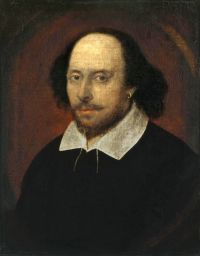
Portrait of William Shakespeare William Shakespeare,  Twelfth Night (1623)

“ SIR ANDREW. 'Twere as good a deed as to drink when a man's a-hungry, to challenge him the field, and then to break promise with him and make a fool of him.
SIR TOBY. Do't, knight; I'll write thee a challenge; or I'll deliver thy indignation to him by word of mouth.
MARIA. Sweet Sir Toby, be patient for to-night; since the youth of the count's was to-day with my lady, she is much out of quiet. For Monsieur Malvolio, let me alone with him: if I do not gull him into a nayword, and make him a common recreation, do not think I have wit enough to lie straight in my bed. I know I can do it.
”
Source: Gutenberg

Portrait of William Shakespeare William Shakespeare,  Twelfth Night (1623)

“ The parts that fortune hath bestow'd upon her, Tell her, I hold as giddily as fortune; But 'tis that miracle and queen of gems That Nature pranks her in attracts my soul.
VIOLA. But if she cannot love you, sir?
DUKE. I cannot be so answer'd.
VIOLA. 'Sooth, but you must. Say that some lady, as perhaps there is, Hath for your love as great a pang of heart As you have for Olivia: you cannot love her; You tell her so. Must she not then be answer'd?
DUKE. There is no woman's sides Can bide the beating of so strong a passion As love doth give my heart: no woman's heart So big to hold so much
”
Source: Gutenberg

Portrait of William Shakespeare William Shakespeare,  Twelfth Night (1623)

“ VIOLA. Art not thou the Lady Olivia's fool?
CLOWN. No, indeed, sir; the Lady Olivia has no folly: she will keep no fool, sir, till she be married; and fools are as like husbands as pilchards are to herrings, the husband's the bigger; I am, indeed, not her fool, but her corrupter of words.
VIOLA. I saw thee late at the Count Orsino's.
CLOWN. Foolery, sir, does walk about the orb like the sun; it shines everywhere. I would be sorry, sir, but the fool should be as oft with your master as with my mistress: I think I saw your wisdom there.
VIOLA. Nay, an thou pass upon me, I'll no more with thee.
”
Source: Gutenberg

Get perspective with Kwize: daily news enlightened by great literature