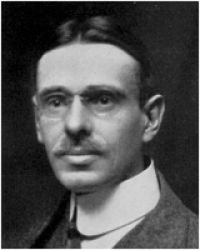
William Tyler Olcott

William Tyler Olcott

Summary

Portrait of William Tyler Olcott William Tyler Olcott Star Lore Of All Ages — Perseus… (1911)

There are two beautiful star clusters in this constellation, situated in the "Sword Hand of the Champion," about midway between the "Segment of Perseus" and Cassiopeia.
Hipparchus refers to them as "a cloudy spot," while Ptolemy called them "a dense mass." They are visible to the naked eye, and present a beautiful appearance in an opera-glass. Seen through a telescope the glory of the sight is indescribable. In one of these clusters at least one hundred stars may be seen in an area less than one quarter as broad as the face of the full moon.
Source: Wikisource

Portrait of William Tyler Olcott William Tyler Olcott Star Lore Of All Ages — Perseus… (1911)

The constellation is 28° in length, one of the most extended in the heavens. Its principal stars form a curved line that bears the name of "the Segment of Perseus," a figure that is almost as much of a stellar landmark as the Great Square of Pegasus.
The most interesting star by far that the constellation contains is the variable "Algol," the so-called "Demon Star," or "Blinking Demon."
The variability of this remarkable star was first scientifically noted by Montanari in 1670, but it is tolerably clear that these light variations had been detected long before his day.
Source: Wikisource

Portrait of William Tyler Olcott William Tyler Olcott Star Lore Of All Ages — Perseus… (1911)

We find among the stellar figures many conflicts of this nature depicted, and in no case do we find man overcome in the struggle that he is engaged in.
Hercules and Ophiuchus are seen respectively trampling underfoot or holding securely gigantic reptiles. The Archer is about to slay the Scorpion, and Orion threatens undismayed the advancing Bull.
Source: Wikisource

Get perspective with Kwize: daily news enlightened by great literature