Summary

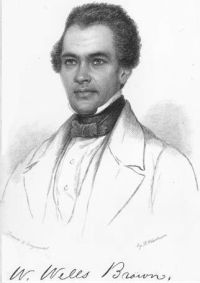
Portrait of William Wells Brown William Wells Brown Three Years in Europe — Letter XXII.

On the passage to Mobile, who should I see among the passengers, but the tall, long-haired man that had eyed me so closely in the slave-market a few days before. His eyes were again on me, and he appeared anxious to speak to me, and I as reluctant to be spoken to. The first evening after leaving New Orleans, soon after twilight had let her curtain down, and pinned it with a star, and while I was seated on the deck of the boat, near the ladies' cabin, looking upon the rippled waves, and the reflection of the moon upon the sea, all at once I saw the tall young man standing by my side.
Source: Wikisource

Portrait of William Wells Brown William Wells Brown Three Years in Europe — Letter XXII.

Mary pleaded, but in vain—George was inflexible. The poor girl left her lover with a heavy heart, regretting that her scheme had proved unsuccessful.
Towards the close of the next day, Mary again appeared at the prison door for admission, and was soon by the side of him whom she so ardently loved. While there, the clouds which had overhung the city for some hours, broke, and the rain fell in torrents amid the most terrific thunder and lightning. In the most persuasive manner possible, Mary again importuned George to avail himself of her assistance to escape from an ignominious death.
Source: Wikisource

Portrait of William Wells Brown William Wells Brown Three Years in Europe — Letter XXII.

But the adherence of George Green to the resolution never to marry, unless to his Mary, is, indeed, a rare instance of the fidelity of man in the matter of love. We can but blush for our country's shame, when we recall to mind the fact, that while George and Mary Green, and numbers of other fugitives from American slavery, can receive protection from any of the Governments of Europe, they cannot return to their native land without becoming slaves.
Source: Wikisource

Get perspective with Kwize: daily news enlightened by great literature