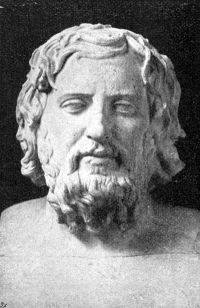

“ To quote a dictum of Simon, what a horse does under compulsion he does blindly, and his performance is no more beautiful than would be that of a ballet-dancer taught by whip and goad. The performances of horse or man so treated would seem to be displays of clumsy gestures rather than of grace and beauty. What we need is that the horse should of his own accord exhibit his finest airs and paces at set signals. ”
Quotes from On Horsemanship (Xenophon)
“ By training him to adopt the very airs and graces which he naturally assumes when showing off to best advantage, you have got what you are aiming at—a horse that delights in being ridden, a splendid and showy animal, the joy of all beholders. ”
“ Under the pleasurable sense of freedom, thanks to the relaxation of the bit, with stately bearing and legs pliantly moving he dashes forward in his pride, in every respect imitating the airs and graces of a horse approaching other horses. ”
“ But possibly you are not content with a horse serviceable for war. You want to find in him a showy, attractive animal, with a certain grandeur of bearing. If so, you must abstain from pulling at his mouth with the bit, or applying the spur and whip—methods commonly adopted by people with a view to a fine effect, though, as a matter of fact, they thereby achieve the very opposite of what they are aiming at. That is to say, by dragging the mouth up they render the horse blind instead of alive to what is in front of him ”
“ It is also well to ascertain by experience if the horse you propose to purchase will show equal docility in response to the whip. Every one knows what a useless thing a servant is, or a body of troops, that will not obey. A disobedient horse is not only useless, but may easily play the part of an arrant traitor. And since it is assumed that the horse to be purchased is intended for war, we must widen our test to include everything which war itself can bring to the proof: such as leaping ditches, scrambling over walls, scaling up and springing off high banks. ”
“ The one best precept—the golden rule—in dealing with a horse is never to approach him angrily. Anger is so devoid of forethought that it will often drive a man to do things which in a calmer mood he will regret. (9) Thus, when a horse is shy of any object and refuses to approach it, you must teach him that there is nothing to be alarmed at, particularly if he be a plucky animal; (10) or, failing that, touch the formidable object yourself, and then gently lead the horse up to it. ”
“ With teaching, practice, and habit, almost any horse will come to perform all these feats beautifully, provided he be sound and free from vice. Only you must beware of a horse that is naturally of a nervous temperament. An over-timorous animal will not only prevent the rider from using the vantage-ground of its back to strike an enemy, but is as likely as not to bring him to earth himself and plunge him into the worst of straits. ”
“ How can a troop of horses be kept free of one another, if driven in this fashion from behind?—whereas a horse accustomed to be led from the side will have least power of mischief to horse or man, and at the same time be in the best position to be mounted by the rider at a moment's notice, were it necessary. ”
“ Take the case of a foal as yet unbroken: it is plain that our scrutiny must begin with the body; an animal that has never yet been mounted can but present the vaguest indications of spirit. Confining ourselves therefore to the body, the first point to examine, we maintain, will be the feet. Just as a house would be of little use, however beautiful its upper stories, if the underlying foundations were not what they ought to be, so there is little use to be extracted from a horse, and in particular a war-horse, (4) if unsound in his feet, however excellent his other points ”
“ With a horse entirely ignorant of leaping, the best way is to take him by the leading rein, which hangs loose, and to get across the trench yourself first, and then to pull tight on the leading-rein, to induce him to leap across. If he refuses, some one with a whip or switch should apply it smartly. The result will be that the horse will clear at a bound, not the distance merely, but a far larger space than requisite; and for the future there will be no need for an actual blow, the mere sight of some one coming up behind will suffice to make him leap. ”
“ What we want is a horse with supple loins, and not supple only but short and strong (I do not mean the loins towards the tail, but by the belly the region between the ribs and thighs) . That is the horse who will be able to plant his hind-legs well under the forearm. If while he is so planting his hind-quarters, he is pulled up with the bit, he lowers his hind-legs on his hocks (2) and raises the forepart of his body, so that any one in front of him will see the whole length of his belly to the sheath. ”
“ In rubbing the horse down, the groom should begin with the head and mane; as until the upper parts are clean, it is vain to cleanse the lower; then, as regards the rest of the body, first brush up the hair, by help of all the ordinary implements for cleansing, and then beat out the dust, following the lie of the hair. The hair on the spine (and dorsal region) ought not to be touched with any instrument whatever; the hand alone should be used to rub and smooth it, and in the direction of its natural growth, so as to preserve from injury that part of the horse's back on which the rider sits. ”
“ The gods have bestowed on man, indeed, the gift of teaching man his duty by means of speech and reasoning, but the horse, it is obvious, is not open to instruction by speech and reasoning. If you would have a horse learn to perform his duty, your best plan will be, whenever he does as you wish, to show him some kindness in return, and when he is disobedient to chastise him. ”
“ The time has come perhaps to add a few suggestions, in case the rider should be called upon to deal with an animal either unduly spirited or again unduly sluggish in disposition. The first point to recognise is, that temper of spirit in a horse takes the place of passion or anger in a man; and just as you may best escape exciting a man's ill-temper by avoiding harshness of speech and act, so you will best avoid enraging a spirited horse by not annoying him. Thus, from the first instant, in the act of mounting him, you should take pains to minimise the annoyance ”
“ When the horse has to be led, we do not approve of leading him from in front, for the simple reason that the person so leading him robs himself of his power of self-protection, whilst he leaves the horse freedom to do what he likes. ”
“ The groom can hardly be too much alive to the following points * * * if any work is to be done: (6) in fact, so important is it that the horse should readily take his bit, that, to put it tersely, a horse that will not take it is good for nothing. Now, if the horse be bitted not only when he has work to do, but also when he is being taken to his food and when he is being led home from a ride, it would be no great marvel if he learnt to take the bit of his own accord, when first presented to him. ”
“ I am far from saying, indeed, that because an animal fails to perform all these parts to perfection, he must straightway be rejected; since many a horse will fall short at first, not from inability, but from want of experience. ”
“ That a horse takes pleasure in swift movement, may be shown conclusively. As soon as he has got his liberty, he sets off at a trot or gallop, never at a walking pace; so natural and instinctive a pleasure does this action afford him, if he is not forced to perform it to excess; since it is true of horse and man alike that nothing is pleasant if carried to excess. ”
“ It is the long steady course rather than the frequent turn which tends to calm a horse. (3) A quiet pace sustained for a long time has a caressing, (4) soothing effect, the reverse of exciting. If any one proposes by a series of fast and oft-repeated gallops to produce a sense of weariness in the horse, and so to tame him, his expectation will not be justified by the result; for under such circumstances a spirited horse will do his best to carry the day by main force, (5) and with a show of temper, like a passionate man, may contrive to bring on himself and his rider irreparable mischief. ”
“ In leaping a ditch or tearing up a steep incline, it is no bad plan to let go the reins and take hold of the mane, so that the animal may not feel the burthen of the bit in addition to that of the ground. In going down a steep incline the rider must throw himself right back and hold in the horse with the bit, to prevent himself being hurled headforemost down the slope himself if not his horse. ”
“ Supposing, when he is in the riding-field, (7) you push him to a gallop until he is bathed in sweat, and when he begins to prance and show his airs to fine effect, you promptly dismount and take off the bit, you may rely upon it he will of his own accord another time break into the same prancing action. Such are the horses on which gods and heroes ride, as represented by the artist. The majesty of men themselves is best discovered in the graceful handling of such animals. (8) A horse so prancing is indeed a thing of beauty, a wonder and a marvel ”
“ But in collecting him, the rider should as little as possible sway the horse obliquely with the bit, and as little as possible incline his own body; or, he may rest assured, a trifle will suffice to stretch him and his horse full length upon the ground. The moment the horse has his eyes fixed on the straight course after making a turn, is the time to urge him to full speed. In battle, obviously, these turns and wheelings are with a view to charging or retiring; consequently, to practise quickening the pace after wheeling is desirable. ”
“ But now, supposing the rider fairly seated, whether bareback or on a saddle-cloth, a good seat is not that of a man seated on a chair, but rather the pose of a man standing upright with his legs apart. In this way he will be able to hold on to the horse more firmly by his thighs; and this erect attitude will enable him to hurl a javelin or to strike a blow from horseback, if occasion calls, with more vigorous effect. The leg and foot should hang loosely from the knee; by keeping the leg stiff, the rider is apt to have it broken in collision with some obstacle ”
“ The horse will take much more kindly to them if you do not confine him to one place and one routine. Since it is a matter of prime necessity that the rider should keep his seat, while galloping full speed on every sort of ground, and at the same time be able to use his weapons with effect on horseback, nothing could be better, where the country suits and there are wild animals, than to practise horsemanship in combination with the chase. ”
“ To put the matter in a nutshell: given that the horse is sound-footed, gentle, moderately fast, willing and able to undergo toil, and above all things (10) obedient—such an animal, we venture to predict, will give the least trouble and the greatest security to his rider in the circumstances of war; while, conversely, a beast who either out of sluggishness needs much driving, or from excess of mettle much coaxing and manoeuvering, will give his rider work enough to occupy both his hands and a sinking of the heart when dangers thicken. ”
“ If, when the groom brings up the horse to his master to mount, he knows how to make him lower his back, (11) to facilitate mounting, we have no fault to find. Still, we consider that the horseman should practise and be able to mount, even if the horse does not so lend himself; (12) since on another occasion another type of horse may fall to the rider's lot, (13) nor can the same rider be always served by the same equerry. ”
“ It is the duty of a horseman, as we think, to have his groom trained thoroughly in all that concerns the treatment of the horse. In the first place, then, the groom should know that he is never to knot the halter (1) at the point where the headstall is attached to the horse's head. By constantly rubbing his head against the manger, if the halter does not sit quite loose about his ears, the horse will be constantly injuring himself ”
“ Washing of the legs we are inclined to dispense with—no good is done but rather harm to the hoofs by this daily washing. So, too, excessive cleanliness of the belly is to be discouraged; the operation itself is most annoying to the horse; and the cleaner these parts are made, the thicker the swarm of troublesome things which collect beneath the belly. Besides which, however elaborately you clean these parts, the horse is no sooner led out than presently he will be just as dirty as if he had not been cleaned. ”
“ Whenever he comes within javelin range he lets fly at the retreating foeman with his blunted missiles; or whenever within spear thrust he deals the overtaken combatant a blow. In coming to close quarters, it is a good plan first to drag the foeman towards oneself, and then on a sudden to thrust him off; that is a device to bring him to the ground. (11) The correct plan for the man so dragged is to press his horse forward: by which action the man who is being dragged is more likely to unhorse his assailant than to be brought to the ground himself. ”
“ Another point to ascertain is whether the horse, when mounted, can be induced to leave other horses, or when being ridden past a group of horses standing, will not bolt off to join the company. Some horses again, as the result of bad training, will run away from the exercising-ground and make for the stable. A hard mouth may be detected by the exercise called the {pede} or volte, (5) and still more so by varying the direction of the volte to right or left. Many horses will not attempt to run away except for the concurrence of a bad mouth along with an avenue of escape home. ”
“ Again, care should be taken to tie the horse up with the halter above his head. A horse's natural instinct, in trying to rid himself of anything that irritates the face, is to toss up his head, and by this upward movement, if so tied, he only slackens the chain instead of snapping it. ”
“ If, however, the wish is to secure a horse adapted to parade and state processions, a high stepper and a showy (1) animal, these are qualities not to be found combined in every horse, but to begin with, the animal must have high spirit and a stalwart body. Not that, as some think, a horse with flexible legs will necessarily be able to rear his body. ”
“ A spirited horse should be kept in check, so that he does not dash off at full speed; and on the same principle, you should absolutely abstain from setting him to race against another; as a general rule, your fiery-spirited horse is only too fond of contention. ”
“ The colt with the longest shanks at the moment of being foaled will grow into the biggest horse; the fact being—and it holds of all the domestic quadrupeds (32) —that with advance of time the legs hardly increase at all, while the rest of the body grows uniformly up to these, until it has attained its proper symmetry. ”
“ If the young horse in walking bends his knees flexibly, you may safely conjecture that when he comes to be ridden he will have flexible legs, since the quality of suppleness invariably increases with age. ”
“ If the possessor of so rare a creature should find himself by chance in the position of a squadron leader or a general of cavalry, he must not confine his zeal to the development of his personal splendour, but should study all the more to make the troop or regiment a splendid spectacle. ”
Common terms
Similar works
New Method of Horsemanship (François Baucher…Lectures on Horsemanship (Unknown…Hints on Horsemanship, to a Nephew and Niece…The Young Lady's Equestrian Manual…Riding for Ladies (W. A. Kerr)Graceful Riding: A Pocket Manual for Equestrians…Horse Training by Modern Methods…The Arabian Art of Taming and Training Wild & Vicious Horses…Notes on equitation and horse training…Patroclus and Penelope: A Chat in the Saddle…
