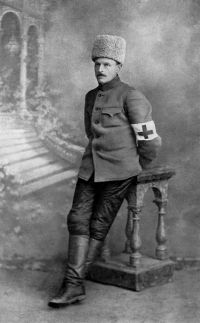
Austro-Hungarian Army

Definition and stakes

R. P. P. Rowe,  A Concise Chronicle of Events of the Great War

“ Total demobilisation of the Austro-Hungarian Army and immediate withdrawal of all Austro-Hungarian forces operating on the front from the North Sea to Switzerland. Within Austro-Hungarian territory, limited as in Clause 3 below, there shall only be maintained as an organised military force a maximum of twenty divisions, reduced to pre-war peace effectives. ”
Source: Gutenberg

G. E. Mitton,  Austria-Hungary (1915)

“ As a composite State, Austria-Hungary plays a forceful part in the concert of the great European nations and wields authority which neither half could achieve alone. The very first necessity of power among modern nations is preparedness for war, and in spite of the curiously differing races and nationalities represented in the Austro-Hungarian army with its two and a half millions of soldiers, the army owns solidarity and force enough to make itself respected. ”
Source: Gutenberg

Oscar Briliant, Arthur W. Holland, Walter A. Phillips,Arthur Hassall, James W. Headlam and Henry W. Steed,  1911 Encyclopædia Britannica, Volume 3… (1911)

“ Since Hungary reserved her right to fix the conditions on which recruits should be granted, the partisans of the Magyar words of command argued that the abolition of the German words of command in the Hungarian regiments might be made such a condition, despite the enumeration in the preceding clause 11, of everything appertaining to the unitary leadership and inner organization of the joint Austro-Hungarian army as belonging to the constitutional military prerogatives of the crown. ”
Source: Wikisource

Get perspective with Kwize: daily news enlightened by great literature