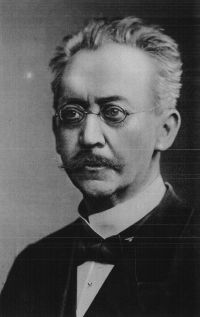
Friedrich von Harnack

Definition and stakes

Portrait of Adolf von Harnack Adolf von Harnack,  History of Dogma, Volume 1

“ The Christian Church and its doctrine were developed within the Roman world and Greek culture in opposition to the Jewish Church. This fact is just as important for the history of dogma as the other stated above, that this Church was continuously nourished on the Old Testament. Christendom was of course conscious of being in opposition to the empire and its culture, as well as to Judaism; but this from the beginning—apart from a few exceptions—was not without reservations. No man can serve two masters ”
Source: Gutenberg

Portrait of Adolf von Harnack Adolf von Harnack,  History of Dogma, Volume 1

“ Not only did he himself expressly declare that the creator of the world is a self-contradictory being of limited knowledge and power, but the whole doctrine of redemption shews that he is a power subordinate to the good God. We need not stop to enquire about the details, but it is certain that the creator of the world formerly knew nothing of the existence of the good God, that he is in the end completely powerless against him, that he is overcome by him, and that history in its issue with regard to man, is determined solely by its relation to the good God. ”
Source: Gutenberg

Portrait of Adolf von Harnack Adolf von Harnack,  History of Dogma, Volume 1

“ Faith assuredly is propagated by the testimony of faith, but dogma is not in itself that testimony.
The peculiar character of the Christian religion is conditioned by the fact that every reference to God is at the same time a reference to Jesus Christ, and vice versa. In this sense the Person of Christ is the central point of the religion, and inseparably united with the substance of piety as a sure reliance on God. Such a union does not, as is supposed, bring a foreign element into the pure essence of religion. The pure essence of religion rather demands such a union
”
Source: Gutenberg

Get perspective with Kwize: daily news enlightened by great literature