“ But she was not Maggy, and words would not come. She heard Meer asking her how soon she could marry him; heard him outline a honeymoon in places that would cure her cough. And all the while she could say nothing. Meer, as happy as a schoolboy, was making an inspection of the room. Love lent a glamour to its cramped proportions and mean appurtenances. His eyes went to the small bed, resplendent now by reason of Maggy's eiderdown; an exasperating little bed nevertheless because it made nearly as many sleep-dispelling noises as the too obtrusive cistern. ”
Maggy
Definition and stakes
The literary concept of "Maggy" emerges as a recurring figure in 19th- and early 20th-century narratives, often embodying themes of domesticity, resilience, and social change. Authors such as Dougal Graham portray her as a central character in stories of courtship and family conflict, while others, like Harriet Beecher Stowe and George Eliot, examine her role within wider societal frameworks.
From the poignant interactions in The Honey-Pot—where Maggy navigates love and obligation—to her depiction as a skilled hunter in Monthly Scrap Book, the character reflects both personal vulnerability and quiet fortitude. These varied portrayals highlight Maggy’s symbolic significance as a figure connecting private emotion with communal life.
Quotes about “Maggy”
Third and second part of the new proverbs on the pride of women… (1835)
“ Up gets Maggy in the morning, against the hoar of nine, whether it be day-light or not, but not without the power of a pearser, for she covers herself with her petticoat, and runs to the dung hill as a soldier to his arms, when alarmed by the drum. ”
The Book of Scottish Song (1843)
“ The sketches of Maggy's wooers, and of the merry-makings held in her house, are of the richest and broadest description, while the touches of pathos that occur in painting the after-desolation of Maggy's abode— "It's aye the dry floor, Meg's—the day e'er sae drookin';" or the emptmess of her garner— —"the warst's when the wee mouse looks out wi' a tear to her, Frae the meal-kist o' Maggy Maclane," are eminently striking. ”
“ And she found Maggy in before her. Maggy had made tea, she had taken off Alexandra's hat and knelt down and drawn off her shoes....Alexandra put down her cup and stretched out her hand across the table. Maggy took it and gave it a squeeze."There's a bit of poetry I learnt once," she said. "I say it whenever I feel the limit. It's a sort of psalm."All's well with the world, my friend,And there isn't an ache that lasts; All troubles will have an end,And the rain and the bitter blasts. There is sleep when the evil is done,There's substance beneath the foam ”
“ It's a flat.""Oh."He got in beside her and set the car going. Maggy had been holding him at arm's length all the afternoon. He was getting a little tired of the pursuit and intended it should end. He could not associate Maggy with protracted virtue. If she persisted in this pose—for he thought it was a pose—he would lose interest in her. He had told her as much at lunch."Oh, rubbish!" Maggy had responded, munching at a pear that only a rich man could afford to buy out of season. "Courting's a change for you.""It's too much trouble. In business I work hard. ”
“ The girl in black was next. Her heart beat uncomfortably fast as she moved down. Had she to pitch her voice to fill that gaping void across the footlights? She shrank from singing to these blasé-looking men who gave the impression of damning before they heard. Then she saw that Maggy was still standing by the table and nodding encouragingly to her. It gave her heart. She handed her song to the pianist and commenced to sing."Louder, please," said some one.She sang louder and lost her nervousness. It was not so difficult to fill that huge auditorium, after all. ”
Monthly scrap book, for February (1832)
“ A Killer.—Little Maggy Smith of Balcaskie, the daughter of the game-keeper there, is a first rate shot. It is not unusual to see Maggy, on a morning, trudging to school with her fowling piece over her shoulder, followed by a number of dogs, who are exceedingly fond of their little mistress, and who regularly participate with her at dinner time, the allowance of bread and cheese with which her pockets are usually plentifully supplied. Maggy is a general favourite in the neighbourhood ”
Dougal Graham, The Whole proceedings of Jocky & Maggy's courtship with the great diversion that ensued at the…
“ Oh, Maggy, tak me an I'll tell you what I hae: First, my father left me when he died, fifty merks, twa sacks, twa pair of sunks; the hens and the gaun gear was to be divided between me and my mither, and if she died first, a' her gear was to come in among mine, and if I died before her, a' my gear was to come back to her again, and her to marry anither man if she could get him But since 'tis sae, she is to gie me Brucky and the black mare, the half o' the cogs, three spoons, and four pair o' blankets and a cannas ”
Dougal Graham, The whole proceedings of Jockey and Maggy (1839)
“ I'm sure mither, I cou'd ne'er get her wi' bairn and my breeks on. Mith. Na, na, poor simple silly lad, the weans no your's, ilka ane loups on anither, an you'll get the wyte of a' the bystarts round about. Up gets Maggy wi' a roar, and rives her hair, claws her back, belly an baith her sides; the weed and gut gaes thro' my flesh like lang needles, nails, or elshin irons. Wae be to the day that e'er I saw his face, I had better hae married a tinkler, or a followed the soger, as mony an honest man's dochter has done, and liv'd a het er life than I do. ”
Dougal Graham, The whole proceedings of Jockey and Maggy (1801)
“ Deed stir, it was then the child was first gotten. Mess John. A John, John, I find you out to be a sinful liver, you and that woman has had carnal dealings for some time; it is ill keeping the cow out of the corn, if she once get a way of going to it, ye should actually have married the poor woman, when ye cohabited so long together. Jock. No, stir, we didna cow-habit together, tho' she kist me, an I kist her, sometimes in the barn, an sometimes in the byre: nane ken't o't but my mither, an she wadna let me tak her, but sent me awa to court our Maggy. ”
 Mary Jane Holmes,
Maggie Miller: The Story of Old Hagar's Secret
Mary Jane Holmes,
Maggie Miller: The Story of Old Hagar's Secret
“ Maggie tried to think so too, and her sleep that night was sweeter than it had been before for many weeks—but the next day came, and the next, and Maggie's eyes grew dim with watching and with tears, for up and down the road, as far as she could see, there came no trace of him for whom she waited."I might have known it; it was foolish of me to think otherwise," she sighed; and, turning sadly from the window where all the afternoon she had been sitting, she laid her head wearily upon the lap of Rose. ”
Henry James, ../../ (1909)
“ Yet when the man had shown her in, had advanced to the tea-table to light the lamp under the kettle and had then busied himself all deliberately with the fire, she made it easy for her host to drop straight from any height of tension and to meet her provisionally on the question of Maggie. While the butler remained it was Maggie that she had come to see and Maggie that—in spite of this attendant's high blankness on the subject of all possibilities on that lady's part—she would cheerfully, by the fire, wait for. ”

“ Then came Uncle Mathew's visit; then Caroline Purdie's disgrace. The count was fully charged. Maggie, that strange girl found in the heart of London's darkness, alone, without friends or parents, was a witch, a devilish, potion-dealing witch, who might, at any time, fly through the night-sky on a broom-stick as surely as any mediaeval old hag. These visions might be exaggerated for many human beings, not so for Grace. Having no imagination she was soaked in superstition. She clung to a few simple pictures, and was exposed to every terror that those pictures could supply. ”
Henry James, ../../ (1909)
“ How did he move and walk, how above all did he, or how would he, look—he who with his so nobly handsome face could look such wonderful things—in case of being left alone with some of the subjects of his wonder? There were subjects for wonder among these very neighbours; only Maggie herself had her own odd way—which didn't moreover the least irritate him—of really liking them in proportion as they could strike her as strange. ”
Mary Jane Holmes,
Maggie Miller: The Story of Old Hagar's Secret
“ And Maggie, listening to the voices which speak to her so oft in the autumn wind, the running brook, the opening flower, and the falling leaf, has learned a lesson different far from those taught her daily by the prim, stiff governess, who, imported from England six years ago, has drilled both Theo and Maggie in all the prescribed rules of high life as practiced in the Old World. She has taught them how to sit and how to stand, how to eat and how to drink, as becomes young ladies of Conway blood and birth. ”
Henry James, ../../ (1909)
“ Maggie had liked her to understand so far as this was possible, but hadn't been slow to see afterwards how the possibility was limited, when one came to think, by mysteries she was not to sound. This inability in her was indeed not remarkable, inasmuch as the Princess herself, as we have seen, was only now in a position to boast of touching bottom. Maggie inwardly lived in a consciousness that she could but partly open even to so good a friend and her own visitation of the fuller expanse of which was for that matter still going on. ”
Mary Jane Holmes,
Maggie Miller: The Story of Old Hagar's Secret
“ Regularly each day, when the sun nears the western horizon, Maggie steals away to the cottage, and the lonely woman, waiting for her on the rude bench by the door, can tell her bounding footstep from all others which pass that way. She does not say much now herself; but the sound of Maggie's voice, talking to her in the gathering twilight, is the sweetest she has ever heard; and so she sits and listens, while her hands work nervously together, and her whole body trembles with a longing, intense desire to clasp the young girl to her bosom and claim her as her own. ”
Mary Jane Holmes,
Maggie Miller: The Story of Old Hagar's Secret
“ She cannot, when she looks upon the beautiful girl who comes each day to her lonely hut, and whom she worships with a species of wild idolatry. Maggie knows not why it is, and yet to her there is a peculiar fascination about that strange old woman, with her snow-white hair, her wrinkled face, her bony hand, and wild, dark eyes, which, when they rest on her, have in them a look of unutterable tenderness. ”
Henry James, ../../ (1909)
“ Maggie's mind, in its restlessness, even played a little with the prospect; the high cool room in its afternoon shade, its old tapestries uncovered, the perfect polish of its wide floor reflecting the bowls of gathered flowers and the silver and linen of the prepared tea-table, drew from her a remark in which this whole effect was mirrored, as well as something else in the Prince's movement while he slowly paced and turned. "We're distinctly bourgeois!" ”
“ This girl, whom Maggie was never to see again hung as a picture in the rooms of her mind for the rest of her life—the youth, the desperate anxiety as of one who throws her last piece upon the gaming-table, the poverty of the shabby black dress, the real physical austerity and asceticism of the white cheeks and the thin arms and pale hands—this figure remained a symbol for Maggie. She used to wonder in after years, when fortune had carried her far enough away from all this world, what had happened to that girl. ”
Mary Jane Holmes,
Maggie Miller: The Story of Old Hagar's Secret
“ Wondrously beautiful is Maggie Miller now, with her bright sunny face, her soft dark eyes and raven hair, so glossy and smooth that her sister, the pale-faced, blue-eyed Theo, likens it to a piece of shining satin. Now, as ever, the pet and darling of the household, she moves among them like a ray of sunshine; and the servants, when they hear her bird-like voice waking the echoes of the weird old place, pause in their work to listen, blessing Miss Margaret for the joy and gladness her presence has brought them. ”
Henry James, ../../ (1909)
“ Kept up a minute longer it would break and collapse—so that Maggie felt herself the next thing turn with a start to her father. "Can't she be stopped? Hasn't she done it enough?"—some such question as that she let herself ask him to suppose in her. Then it was that, across half the gallery—for he hadn't moved from where she had first seen him—he struck her as confessing, with strange tears in his own eyes, to sharp identity of emotion. "Poor thing, poor thing"—it reached straight—"isn't she, for one's credit, on the swagger?" ”
Ellen Tracy Alden, Stories and ballads for young folks (1879)
“ Peeps forth, with little MaggieHas any fault to find. [234] When winsome little Maggie,With basket on her arm,In which her father’s luncheonIs wrapped so nice and warm— When she enters the long workshopAnd pauses at his side,Quick down he lays his hammerAnd turns in love and pride, To look into her limpid eyes,And stroke her sunny hair,And jest and frolic with her—Forgetting toil and care— For the music of her laughterAnd the mirth of her replies,The while there’s not a happier man,Or richer, ’neath the skies. ”
Henry James, ../../ (1909)
“ After which he brought up more slowly: "If ever a man since the beginning of time acted in good faith—!" But he dropped it, offering it simply for that. For that then when it had had time somewhat to settle like some handful of gold-dust thrown into the air, for that then Maggie showed herself as deeply and strangely taking it. "I see." And she even wished this form to be as complete as she could make it. "I see." The completeness had clearly after an instant struck him as divine. "Ah my dear, my dear, my dear—!" It was all he could say. ”
 Harriet Beecher Stowe,
We and Our Neighbors; or, The Records of an Unfashionable Street
Harriet Beecher Stowe,
We and Our Neighbors; or, The Records of an Unfashionable Street
“ There was a time in Maggie's life when a kind, judicious, thoughtful, Christian woman might have kept her from falling, might have won her confidence, become her guide and teacher, and piloted her through the dangerous shoals and quicksands which beset a bright, attractive, handsome young girl, left to make her own way alone and unprotected. ”
Henry James, The Golden Bowl — Volume 2
“ And I can't," said Maggie, "speak of him.""You 'can't'—?""I can't." She said it as for definite notice, not to be repeated. "There are too many things," she nevertheless added. "He's too great."The Prince looked at his cigar-tip, and then as he put back the weed: "Too great for whom?" Upon which as she hesitated, "Not, my dear, too great for you," he declared. "For me—oh, as much as you like.""Too great for me is what I mean. I know why I think it," Maggie said. "That's enough."He looked at her yet again as if she but fanned his wonder ”
Henry James, The Golden Bowl — Volume 2
“ Maggie had gone through the form of recalling this, and the light of their ancient candour, shining from so far back, had seemed to bring out some things so strangely that, with the sharpness of the vision, she had risen to her feet. "Well, with a 'life' Fawns will certainly do." ”
 Mathilde Blind,
George Eliot
(1883)
Mathilde Blind,
George Eliot
(1883)
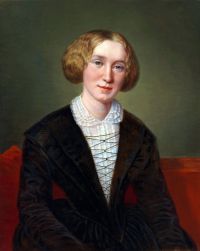
“ But Maggie has more actual affinity with poets and artists than with saints and martyrs. Her soul thrills like a finely-touched instrument to the beauty of the world around her, and though she doubts whether there may not even be a sinfulness in the indulgence of this enjoyment, yet the summer flowers and the summer sunshine put her scruples to flight. ”
Henry James, ../../ (1909)
“ This meaning was that she had decided, that she had been infinitely conscious of Maggie's presence before, that she knew she should at last find her alone, and that she wanted her, for some reason, enough to have presumably called on Bob Assingham for aid. He had taken her chair and let her go, and the arrangement was for Maggie a signal proof of her earnestness; of the energy in fact, that, though superficially commonplace in a situation in which people weren't supposed to be watching each other, was what affected our young woman on the spot as a breaking of bars. ”
Henry James, The Golden Bowl — Complete
“ Extraordinary, beyond question, was one branch of his characteristic mute wonderment—it characterised above all, with its subject before it, his modesty: the strange dim doubt, waking up for him at the end of the years, of whether Maggie’s mother had, after all, been capable of the maximum. The maximum of tenderness he meant—as the terms existed for him; the maximum of immersion in the fact of being married. Maggie herself was capable ”
 George Eliot,
The Mill on the Floss
George Eliot,
The Mill on the Floss
“ Hanging diligently over her sewing, Maggie was a sight any one might have been pleased to look at. That new inward life of hers, notwithstanding some volcanic upheavings of imprisoned passions, yet shone out in her face with a tender soft light that mingled itself as added loveliness with the gradually enriched colour and outline of her blossoming youth. Her mother felt the change in her with a sort of puzzled wonder that Maggie should be “growing up so good” ”
