“ An Alban name, but mix'd with Dardan blood, Born in the covert of a shady wood: Him fair Lavinia, thy surviving wife, Shall breed in groves, to lead a solitary life. In Alba he shall fix his royal seat, And, born a king, a race of kings beget. Then Procas, honor of the Trojan name, Capys, and Numitor, of endless fame. A second Silvius after these appears; Silvius Aeneas, for thy name he bears; For arms and justice equally renown'd, Who, late restor'd, in Alba shall be crown'd. How great they look! how vig'rously they wield Their weighty lances, and sustain the shield! ”
Silvius
Definition and stakes
Quotes about “Silvius”
The Junior Classics, Volume 3: Tales from Greece and Rome
“ That youth who leans upon a pointless spear is Silvius, thy youngest child, whom Lavinia shall bear to thee in thy old age. He shall reign in Alba, and shall be the father of kings. And many other kings are there who shall build cities great and famous. Lo! there is Romulus, whom Ilia shall bear to Mars. He shall build Rome, whose empire shall reach to the ends of the earth and its glory to the heaven. Seest thou him with the olive crown about his head and the white beard? That is he who shall first give laws to Rome. And next to him is Tullus, the warrior. ”

William Shakespeare,
As You Like It
“ Silvius] I will content you if what pleases you contents you, and you shall be married to-morrow. [To ORLANDO] As you love Rosalind, meet. [To SILVIUS] As you love Phebe, meet;- and as I love no woman, I'll meet. So, fare you well; I have left you commands. SILVIUS. I'll not fail, if I live. PHEBE. Nor I. ORLANDO. Nor I. ExeuntSCENE III. The forest Enter TOUCHSTONE and AUDREY TOUCHSTONE. To-morrow is the joyful day, Audrey; to-morrow will we be married. AUDREY. I do desire it with all my heart; and I hope it is no dishonest desire to desire to be a woman of the world. ”
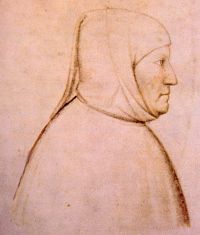
Francesco Petrarca,
Petrarch, the First Modern Scholar and Man of Letters
“ The inaccessible peak, which Monicus upbraids Silvius for struggling toward, panting and exhausted though he is, is the height of fame, the rarer sort of fame, which but few succeed in attaining to. The deserts where Silvius is said to wander are scholarly pursuits. These to-day are desert places indeed, being in some cases forsaken outright, through love of money, in others despaired of and neglected, in consequence of intellectual sluggishness. The mossy rocks are the rich and great, the moss being their inherited wealth, which has slowly gathered about them. ”
Francesco Petrarca,
Petrarch, the First Modern Scholar and Man of Letters
“ The bristling forest and the mountains that rise into the air, at which Silvius is amazed because they do not follow after these sweet singers, are the uncultivated multitude and the persons who occupy high stations. ”
Francesco Petrarca,
Petrarch, the First Modern Scholar and Man of Letters
“ Murmuring fountains can be used of men of letters and of those who have the gift of eloquence, inasmuch as little streams of intellectual influence flow from the well-springs of genius that are within them, with a sound, so to speak, that charms and delights us. As for Silvius' swearing by Pales, that is a shepherd oath, for Pales is the shepherds' goddess. We may understand there Mary, who is not a goddess, to be sure, but yet is the mother of God. Parthenias is Virgil himself. ”
Cassius Dio,
Dio's Roman History
(1914)
“ After the death of Ascanius it was not his son lulus who became king, but Silvius, the son of Aeneas by Lavinia — or, according to some, Ascanius' son Silvius. Silvius begat another Aeneas, whose son was Latinus, whose son was Capys; Capys had a son Tiberinus, whose son was Amulius, whose son was Aventinus. It is impossible for mortal man either to foresee all that is to happen or to find a way of turning aside the inevitable: of this very maiden [Rhea Silvia] were to be born the avengers of his crime. ”
Various, Bentley's Miscellany, Volume I
“ He joins his old antagonist the usurping Duke in his fallen fortunes; he had spurned him in his prosperity: his restored friend he bequeaths to his former honour, deserved by his patience and his virtue,—he compliments Oliver on his restoration to his land, and love, and great allies,—wishes Silvius joy of his long-sought and well-earned marriage,—cracks upon Touchstone one of those good-humoured jests to which men of the world on the eve of marriage must laughingly submit,—and makes his bow. ”
William Hazlitt, Characters of Shakespeare's Plays
“ The unrequited love of Silvius for Phebe shows the perversity of this passion in the commonest scenes of life, and the rubs and stops which nature throws in its way, where fortune has placed none. Touchstone is not in love, but he will have a mistress as a subject for the exercise of his grotesque humour, and to show his contempt for the passion, by his indifference about the person. He is a rare fellow. He is a mixture of the ancient cynic philosopher with the modern buffoon, and turns folly into wit, and wit into folly, just as the fit takes him. ”
William Shakespeare,
As You Like It
(1623)
“ SILVIUS Call you this chiding? CELIA Alas, poor shepherd! ROSALIND Do you pity him? no, he deserves no pity.—Wilt thou love such a woman?—What, to make thee an instrument, and play false strains upon thee! Not to be endured!—Well, go your way to her, —for I see love hath made thee a tame snake,—and say this to her;—that if she love me, I charge her to love thee; if she will not, I will never have her unless thou entreat for her.—If you be a true lover, hence, and not a word; for here comes more company. ”
Francesco Petrarca,
Petrarch, the First Modern Scholar and Man of Letters
“ The nymphs, the goddesses of the fountains, are the divine minds of scholars. The threshold over which Monicus invites Silvius to pass is that of the Carthusian order, into which assuredly no one has ever been lured by deception, or against his will, as many persons have been into other religious bodies. The shepherd whose singing Monicus prefers to Homer and Virgil is no other than David. The mention of singing to the psaltery is peculiarly appropriate in his case, because of the psalms, which are his work. ”
active 796 Nennius, History of the Britons (Historia Brittonum…
“ Other MSS. Silvius. (2) V.R. Who should slay his father and mother, and be hated by all mankind. (3) V.R. He displayed such superiority among his play- fellows, that they seemed to consider him as their chief. (4) Tours. 11. Aeneas reigned over the Latins three years; Ascanius thirty three years; after whom Silvius reigned twelve years, and Posthumus thirty-nine * years: the latter, from whom the kings of Alba are called Silvan, was brother to Brutus, who governed Britain at the time Eli the high-priest judged Israel, and when the ark of the covenant was taken by a foreign people. ”
Joseph Addison,
The Tatler, Volume 4
“ They are both very sober men, neither of their persons is disagreeable, nor did I know which to prefer till I had heard them discourse; when the conversation of Philander so much prevailed, as to give him the advantage, with me, in all other respects. My mother pleads strongly for Silvius, and uses these arguments, that he not only has the larger estate at present, but by his good husbandry and management increases it daily; that his little knowledge in other affairs will make him easy and tractable; whereas (according to her) men of letters know too much to make good husbands. ”
active 796 Nennius, History of the Britons (Historia Brittonum…
“ Aeneas, after the Trojan war, arrived with his son in Italy; and Having vanquished Turnus, married Lavinia, the daughter of king Latinus, who was the son of Faunus, the son of Picus, the son of Saturn. After the death of Latinus, Aeneas obtained the kingdom Of the Romans, and Lavinia brought forth a son, who was named Silvius. Ascanius founded Alba, and afterwards married. And Lavinia bore to Aeneas a son, named Silvius; but Ascanius (1) married a wife, who conceived and became pregnant. ”
Joseph Addison,
The Tatler, Volume 4
“ To part of this I imagine I answer effectually, by saying, Philander's estate is large enough; that they who think £2000 a year sufficient, make no difference between that and three. I easily believe him less conversant in those affairs, the knowledge of which she so much commends in Silvius; but I think them neither so necessary or becoming in a gentleman as the accomplishments of Philander. It is no great character of a man to say, he rides in his coach and six, and understands as much as he who follows his plough. ”
William Shakespeare,
As You Like It
(1919)
“ Silvius, the time was that I hated thee; 92 And yet it is not that I bear thee love: But since that thou canst talk of love so well, Thy company, which erst was irksome to me, I will endure, and I'll employ thee too; 96 But do not look for further recompense Than thine own gladness that thou art employ'd. Sil. So holy and so perfect is my love, And I in such a poverty of grace, 100 That I shall think it a most plenteous crop To glean the broken ears after the man That the main harvest reaps: loose now and then A scatter'd smile, and that I'll live upon. ”
Virgil,
The Æneids of Virgil, Done into English Verse
“ In long array, and learn each face as 'neath their eyes it came. "Come now, and I of Dardan folk will tell the following fame, And what a folk from Italy the world may yet await, Most glorious souls, to bear our name adown the ways of fate. [Pg 179] Yea, I will set it forth in words, and thou thy tale shalt hear: Lo ye, the youth that yonder leans upon the headless spear,760 Fate gives him nighest place today; he first of all shall rise, Blent blood of Troy and Italy, unto the earthly skies: Silvius is he, an Alban name, thy son, thy latest born ”
Bernard Beckerman, Shakespeare at the Globe, 1599-1609
“ Hamlet unable to avenge his father is contrasted with Laertes too ready to avenge his father, Hamlet mad is contrasted with Ophelia mad, Rosalind’s mocking love-play is heightened by comparison with Phebe and Silvius as well as with the earthy affection of Touchstone and Audrey, while Touchstone’s professional mockery of the pastoral life casts light upon Jaques’ melancholy. One could go on endlessly pointing out the contrast of situation with situation. Frequently we encounter scenes whose only relationship to the story is to provide dramatic contrast. ”
Cassius Dio,
Dio's Roman History
(1914)
“ Now Latinus and Turnus, king of the Rutuli, perished in war at each other's hands, whereupon Aeneas became king. And when Aeneas also had been killed in war at Laurentum by the same Rutuli and Mezentius the Etruscan, while Lavinia his wife was pregnant of Silvius, Ascanius the son of the case of other essential facts. For, while I shall recount the history of the Romans in full, to the best of my ability, outside of that only what has a bearing on their affairs will be recorded. ”
Jacob Burckhardt, The Civilisation of the Renaissance in Italy
“ A century later the woman-professor would have been added to these. For the famous woman of the House of Este, see Ariosto, Orl. xiii. [345] Bartolommeo Facio and Paolo Cortese. B. F. De Viris Illustribus Liber, was first published by L. Mehus (Florence, 1745) . The book was begun by the author (known by other historical works, and resident at the court of Alfonso of Naples) after he had finished the history of that king (1455) , and ended, as references to the struggles of Hungary and the writer’s ignorance of the elevation of Æneas Silvius to the cardinalate show, in 1456. ”
W. W. Greg, Pastoral Poetry & Pastoral Drama
“ Tasso's Silvia and Guarini's Silvio alike are silvan not in name only, but are truly figures of the woods, hunters of the wolf and boar; while the same distinction survives in a modified form in Daniel's Hymen's Triumph, in which the ruder characters, Montanus and the rest, are described as foresters. The contrast appears sharply in the Maid's Metamorphosis in the characters of Silvio and Gemulo; more faintly indicated by Randolph in Laurinda's lovers, of whom one frequents the woods and one the plains. The pastoral and forest traditions are in their essence and history indistinguishable. ”
Ivan Turgenev,
Stories by Foreign Authors
(1898)
“ We asked each other in astonishment: "Can it be possible that Silvio is not going to fight?" Silvio did not fight. He was satisfied with a very lame explanation, and became reconciled to his assailant. This lowered him very much in the opinion of all our young fellows. Want of courage is the last thing to be pardoned by young men, who usually look upon bravery as the chief of all human virtues, and the excuse for every possible fault. But, by degrees, everything became forgotten, and Silvio regained his former influence. ”
Johanna Spyri, Rico and Wiseli
“ Rico began to give an account of the journey after they had finished eating, and Stineli meanwhile quietly replaced every thing in the cupboard; for she knew well enough, without being told, how such work should be done. Then she seated herself by Silvio's bedside, and made shadow pictures on the wall with her supple fingers; and Silvio laughed aloud, and called the names,—"A hare! A beast with horns! A spider with long legs!" ”
Johanna Spyri, Rico and Wiseli
“ Once again the golden sun of autumn burnished the surface of the Lake of Garda, and the heavens lay blue above the tranquil waves. In the garden the great bunches of grapes hung gold against the trellises, and the red flowers of the oleander glistened in the sunbeams.It was quiet in Silvio's room, for his mother was without in the garden gathering grapes and figs for the evening. The invalid lay listening for Rico's step, for this was the time of his usual visit. The wicket opened: Silvio pulled himself up in his bed. A long black coat came slowly toward the door,—it was the priest. ”
Prosper Mérimée,
The Writings of Prosper Mérimée
(1906)
“ Silvio took the chalk and marked down what was due him. The officer, convinced that there was a mistake, made some objections. Silvio, still mute, went on dealing as if he had not heard. The officer, out of patience by this time, took the brush and wiped off the figures. Silvio picked up the chalk and wrote them down again. At this, the officer, excited by the wine, by the play and the laughter of his comrades, and thinking he had been insulted, took up a brass candlestick and hurled it at Silvio, who by bending aside, averted the blow. ”
Giuseppe Garibaldi, Rule of the Monk; Or, Rome in the Nineteenth Century
“ Silvio, it must be known, was well acquainted with the castle of Lucullus, where he had often been a guest, as well as the associate of Orazio in his hunting and fighting expeditions. Through him a communication was kept up between the Liberals in the city and those in the country. Before quitting Rome he had come to the determination of taking the field, and placing himself under Orazio's flag, and, as we have seen, he happily arrived with his associates just in time to give the last blow to the Papal soldiers. ”
L. Frank Baum,
Mary Louise Solves a Mystery — Chapter XIII. SILVIO'S GOLD
(1917)
“ You'd betray me?""Not if I have the gold—here, in my hand—now, Signore."Jones grew red and then white. He eyed the man wickedly. He scowled, and Silvio smiled pleasantly. Silvio was big for an Italian; big and brawny; as his smile faded his face assumed a look of stubborn determination."So you want the gold now, Silvio?""At once, if it please the Signore. The gendarmes are ugly if the law is broken. Their jails are not as pleasant as the grape-house. So the gold must be twice the amount we had spoken of, Signore." ”
“ Silvio," she added, looking at him, shyly, "for the love of God, go! It is getting late. At any moment they may be coming to look for me. No—not again—""But I must speak with you here to-morrow—the day after," urged Silvio."Yes," said Bianca, hurriedly. "I must think," she added. "We must confide everything now to Mademoiselle Durand. Ah, Silvio, you should not have loved me—I shall bring you unhappiness."Silvio looked at her gravely. "If we are true to each other," he said, "everything must come right. ”
Aleksandr Sergeevich Pushkin, The Prose Tales of Alexander Pushkin
“ The guests had departed, and we two were left alone. Sitting down opposite each other, we silently lit our pipes. Silvio seemed greatly troubled; not a trace remained of his former convulsive gaiety. The intense pallor of his face, his sparkling eyes, and the thick smoke issuing from his mouth, gave him a truly diabolical appearance. Several minutes elapsed, and then Silvio broke the silence. ”