
“ Wemyss's wonderful and unselfish motives in suggesting the continent, but she and Lucy were in that state when the idea of an hotel and waiters and a band was simply impossible to them, and all they wished was to creep into the quiet and privacy of their own nest,—'Like wounded birds,' said poor Miss Entwhistle, looking up at him with much the piteous expression of a dog lifting an injured paw.'It's very bad for Lucy to be encouraged to think she's a wounded bird,' said Wemyss, controlling his disappointment as best he could. ”
Quotes about “Wemyss”
“ Mr. Wemyss was most good-natured, and she was sure, and as she knew from experience, was most kind and thoughtful; but the things he said were so very unlike the things Jim said, and his way of looking at things was so very unlike Jim's way. Not that there wasn't room in the world for everybody, Miss Entwhistle reminded herself, sitting at her tea-table observing Wemyss, who looked particularly big and prosperous in her small frugal room, and no doubt one star differed from another in glory; still, she did wonder at Jim. ”
James Grant, The Scottish Cavalier: An Historical Romance…
“ William Wemyss, a veteran serjeant of Dunbarton's musqueteers, became his patron and protector; and a love and friendship sprang up between them, for the orphan had none other to cling to. Wemyss often led him to the old churchyard, and showed him the grave where his mother lay—where the soldiers had interred her; and there little Walter, overcome by the mystery that involved his fate, and the loneliness of his heart, wept bitterly ”
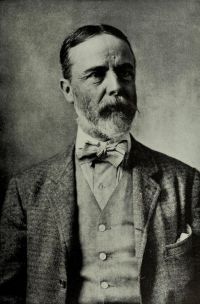 Frederic Jesup Stimson,
First harvests
(1888)
Frederic Jesup Stimson,
First harvests
(1888)
“ Wemyss and Arthur sat down in one corner of the terrace and lit their cigars comfortably.“Derwent,” said Mr. Wemyss, “is one of those fanatics who do more harm, from their position and education, than any leader of the proletariat. But all women rave about him; for women are all hero-worshippers.”“Mrs. Gower has asked him to go on the coaching party,” said Arthur, secretly flattered at being thought by Wemyss worthy of hearing that gentleman’s opinion. ”
 Lilian Bell,
At Home with the Jardines
Lilian Bell,
At Home with the Jardines
“ Jimmie and Bee were plainly impressed."My sister is very fond of her life here," declared Bee. "I found Peach Orchard a perfect pastoral when I first came."Jimmie had been smoking thoughtfully, with a frown of perplexity on his brow. Suddenly he spoke."I think Sir Wemyss is right," he answered. "Now, why not all of us take a hand at farming, so to speak, while we are here? I never have, but I know I could. Anyhow I mean to try. To-morrow, let's go at it and prune the trees.""It is not the proper season to prune trees," observed Sir Wemyss. ”
1911 Encyclopædia Britannica, Volume 28… (1911)
“ WEMYSS, a parish of Fifeshire, Scotland, embracing the villages of East and West Wemyss and the police burgh of Buckhaven, a fishing port lying on the northern shore of the Firth of Forth, 21⁄2 m. S W of Leven, on the North British Railway Company's branch line from Thornton Junction to Methil. Coal mining is the principal industry of the district, the coal being exported from the port of Methil, of which the harbour was constructed by David, 2nd earl of Wemyss (d. 1670) , the town being made a burgh of barony in 1662. ”
Lilian Bell,
At Home with the Jardines
“ Jimmie grinned sheepishly as the Angel extricated him, and placed a strong board on the barrel for him to stand upon in safety.Then Jimmie decided to saw a dead limb off, and leave the pruning to Sir Wemyss. So he took the saw and went valiantly to work, but it was tiresome, so he leaned his weight against the limb and industriously sawed his prop off, which sent him flying almost into Lady Mary's lap. He saved himself by his nimbleness, but this time Jimmie was mad—uncompromisingly mad. ”
T. Wemyss Reid, Memoirs of Sir Wemyss Reid 1842-1885
“ Of all his qualities none was more attractive than the staunchness of his friendship. To those whom he really liked, old or young, eminent or obscure, Wemyss Reid was always the same, a champion who would brook no slight, and whose help was readiest when times were worst. A literary man, he was quite without literary jealousy, and never so happy as when giving a hand-up to a new writer or a young journalist. ”
“ Some one in this house has actually dared——''There's the tuner,' said the parlourmaid tentatively, not sure if that would be an explanation, for Wemyss's lucid sentences, almost of a legal lucidity, invariably confused her, but giving the suggestion for what it was worth. 'I understood the orders was to let the tuner in once a quarter, sir. Yesterday was his day. He played for a hour. And 'ad the baize and everything off, and the lid leaning against the wall.'True. True. The tuner. Wemyss had forgotten the tuner. The tuner had standing instructions to come and tune. ”
“ But however good Wemyss's business record might be, it couldn't alter their violent objection to Jim's daughter marrying him. Apart from the stuff he talked, there was the inquest. They were aware that in this they were unreasonable, but they were all too much attached to Jim's memory to be able to be reasonable about a man they felt so certain he wouldn't have liked. Singly and in groups they came at safe times, such as after breakfast, to Eaton Terrace to reason with Lucy, too much worried to remember that you cannot reason with a person in love. ”
 Leslie Stephen,
Dictionary of National Biography…
(1899)
Leslie Stephen,
Dictionary of National Biography…
(1899)
“ John Wemyss, the commissary of St. Andrews University, a strong supporter of the crown; John Wemyss (d. 1659) , minister of Cuikstone, afterwards Kinnaird in Brechin, who was equally zealous in opposing the ecclesiastical innovations of James VI and Charles I; John Wemyss (d. 1632?) , minister of Nigg in Aberdeenshire, and John Wemyss (d. 1640) , minister of Rothes, who was reputed a brother of John, first earl of Wemyss. [Wemyss's Works; Douglas's Baronage, i. 553; Scot's Fasti Eccles. Scoticanæ, I. ii. 403, 440; Calderwood's Hist. of the Kirk of Scotland (Wodrow Soc.) , vol. vii. passim.] ”
Mary C. E. Wemyss, Oranges and lemons (1919)
“ So when she was thrown from the pony and lay in her bed unconscious, a black cloud hung over the Lodge of Glenbossie, and Marcus, in the depths of despair, wandered here and there unable to do anything because he had done everything that could be done and it had not availed. Sandy and John just stood around, to be there if anything should happen—and nothing happened, that was the worst of it. Anything—excepting, of course, one thing—would be better than this lying still—conscious of nothing. ”
Multiple, Dictionary of National Biography… (1927)
“ WEMYSS-CHARTERIS-DOUGLAS, FRANCIS, tenth Earl of Wemyss and March (1818–1914) , politician, the eldest son of Francis Wemyss-Charteris-Douglas, ninth Earl, by his wife, Lady Louisa Bingham, third daughter of Richard, second Earl of Lucan, was born in Edinburgh 4 August 1818. He was educated at Edinburgh Academy, Eton, and Christ Church, Oxford, where John Ruskin was his contemporary. He graduated B.A. in 1841. In the same year he was returned to parliament in the conservative interest as member for East Gloucestershire, which he represented until January 1846, when he resigned his seat. ”
1911 Encyclopædia Britannica, Volume 28… (1911)
“ WEMYSS, EARLS OF, the title held by a Scottish family who had possessed the lands of Wemyss in Fifeshire since the 12th century, and of which various members had attained distinction. In 1628 Sir John Wemyss, who had been created a baronet in 1625, was raised to the peerage as Baron Wemyss of Elcho; and in 1633 he became earl of Wemyss, and Baron Elcho and Methel, in the peerage of Scotland. ”
Lilian Bell,
At Home with the Jardines
“ Billy looked distressed."Their horns are very strong!" he urged. "I don't believe it would hurt them one bit. And you might give me one of those little bottles I saw Mr. Jimmie open—you remember the little one you had after the two big ones, don't you, Mr. Jimmie?""Oh, yes, Billy," I said. "Mr. Jimmie remembers. (You'd be ashamed not to, wouldn't you, Jimmie?) ""You think you're funny," growled Jimmie, witheringly, as Sir Wemyss and Captain Featherstone broke out afresh, and even Artie Beg left off looking at Cary long enough to smile at Jimmie's scarlet face and Mrs. Jimmie's anxious one. ”
Mary C. E. Wemyss, Oranges and lemons (1919)
“ There were more sparrows than there should be in a good woman’s garden. They needed a fright, that was all. Low-growing gooseberries there were within the reach of the shortest-legged and best-bred spaniel. He gave up the remote chance of healing by the scraping up and down of feet, and was off in the wake of the yellow cat, flushing sparrows as he went. The brambles did for him what his mistress would not. But brambles, being self-taught scratchers, have not the firmness of touch desirable; moreover, they don’t know when to leave go, or how.“Marcus, do you hear me when I speak?” ”
Mary C. E. Wemyss, The Professional Aunt
“ For a fairyland it assuredly is, if she is lucky enough to find the right guide. He must, to begin with, believe in the fairyland. He must know that the path may be rough at times, stony and overgrown with weeds, but he will know that all the difficulties will be worth while when he brings her out into the open, and they look away to the limitless horizon of happiness. A few hours later, Pauline said to me at breakfast, "Betty, I think I shall tell that bootmaker to make me two pairs of boots and two pairs of shoes. It is better to have enough while one is about it, don't you think so?" ”
| section_author, The Strand Magazine, Volume 3, Issue 15…
“ Lord Wemyss has always played a very independent part in politics. When Lord Elcho, he was very widely and popularly known through his connection with the Volunteer movement and the National Rifle Association. ”
T. Wemyss Reid, Memoirs of Sir Wemyss Reid 1842-1885
“ No man ever set a higher value on this high connection, which, after all, whether brought about by kinship, or sympathy, or association, or gratitude, or stress, is under Heaven the surest solace of our poor humanity; and so it coloured and guided the life of Wemyss Reid. ”
Mary C. E. Wemyss, The Professional Aunt
“ Betty handed it to me. "Here, Sara," I said, "I have got a darling white rabbit for you! Sara! A bunny!" "Yaya's got a blush upstairs, a lubbly blush," she said, disdaining even to look at the parcel. I held it toward her, undid it, I squeaked the squeak, I called the rabbit endearing names; but to no purpose. Sara looked the other way. ”
T. Wemyss Reid, Memoirs of Sir Wemyss Reid 1842-1885
“ In the evening of Thursday, February 23rd, he was taken ill, and before ten o'clock on Sunday morning he was dead. During the seventeen months which elapsed from the time of the doom pronounced by his physicians until its fulfilment, Wemyss Reid so demeaned himself that none could have penetrated his secret. He was as gay and high in spirit, as strenuous in work, as thoughtful for others, as ever; so that those who knew the fatal truth could not bring themselves to believe it. ”
Mary C. E. Wemyss, The Professional Aunt
“ Because the house is to be full of William's friends and he is never perfectly at ease unless there is a bishop among them, and a bishop drives me to desperate deeds of wickedness. They always like me! Betty, in your capacity of professional something, think of me. I want helping more than any one. I don't ask you to give up Cornwall, but afterwards, don't disappoint your JULIA. A girl's: Dear Miss Lisle,—I wonder if you will remember me. I am almost afraid to hope so. But I met you last summer at the Anstells' garden-party, and you passed me an ice, vanilla and strawberry mixed! ”
Mary C. E. Wemyss, Oranges and lemons (1919)
“ She was of so delightful a nature that what she enjoyed she wanted others to enjoy. The thought of Mr. Pease riding up and down Bestways hills on his bicycle, ministering to the souls and bodies of old men and women, seemed, viewed from the moors of Scotland, where souls had such a chance, rather a sad lot. Uncle Marcus could well afford to give both Mr. Pease and Mr. Watkins a holiday. They would never question the smallness of the rent asked for the fishing, so Marcus could hide his light under a bushel and could easily escape the thanks he dreaded. ”
Mary C. E. Wemyss, Oranges and lemons (1919)
“ If a man were a true Christian—and all fishermen should be that, for the earliest of all Christians were fishermen before anything else—he would give the rod oftener to the gillie who stands beside him, knowing himself to be by far the better fisherman of the two. For hours he stands there with that certain knowledge biting into his heart.If Marcus had told Sandy all that lay in his heart, Sandy would have been profoundly interested, no doubt, because he had had cause, in his time, to think of women as interfering creatures—and of small use in a world of God-fearing men. ”
Mary C. E. Wemyss, The Professional Aunt
“ She never gets into a 'bus or takes any vehicular advantage over a widow, and she feels choky if she sees any one very old. "Do you know why?" she asked. "Because they are, so near Heaven, and sometimes I think you see the reflection of it in their faces." "Like Cousin Penelope," I said. We arrived at the shop where the coat and skirt were to be had, and Pauline, having admired the horse and thanked the cabman, and the commissionaire, who held his arm over a perfectly dry wheel, followed me into the shop. ”
Mary C. E. Wemyss, The Professional Aunt
“ She never asks one to shop for her, but with her, which is perhaps an even greater test of friendship. On a particularly hot day, I remember, a letter came from Pauline which announced her immediate arrival. I was, waiting in the hall for her, ready to start, which is a stipulation she always makes, as she says it is such a pity to waste time. She greeted me in the same rather tempestuous manner that I am accustomed to at the hands of Betty and Hugh, and then she ran down the steps again to tell the cabman that he had a very nice horse, which she patted, and said, "Whoa, mare!" ”
Mary C. E. Wemyss, Oranges and lemons (1919)
“ But he knew better: even mere man knows what danger there lies to the future of England in the snare of the “satisfoyer.” But Marcus was too busy to think of the future of England and her citizens; he was frightfully busy. He had just time to find the baby’s “satisfoyer,” and to find the baby the ugliest he had ever seen, and was off on his search for Shan’t. What should he say to Sibyl if he should fail to find her? To that detestable aunt? To Diana? ”
Mary C. E. Wemyss, Oranges and lemons (1919)
“ Her mind being full of islands, having heard much of one from Miles Hastings, she bethought herself of a bird-island that lay out to sea at some distance from the end of the Loch, and on that island she proposed Uncle Marcus and the other men should spend some time together. Marcus was perfectly willing. He was interested in sea-birds and loved the sea; moreover, he was always anxious to do anything Diana asked him to do, in the hope, perhaps, that Aunt Elsie would have proved in like circumstances less amenable. There was always that incentive to an extreme amiability. ”
Mary C. E. Wemyss, Oranges and lemons (1919)
“ A man may build his house on what he wills,A child with sand her painted bucket fills. Diana wrote to her uncle and said poor Shan’t wanted to go to the seaside, but Aunt Elsie could not manage to take her there. Poor little Shan’t! She did so love the sea, and her legs were so pale!“Selfish woman,” said Marcus; “why couldn’t she make an effort?” To some children the seaside was an absolute necessity. ”
Mary C. E. Wemyss, The Professional Aunt
“ I should so much like you to see something of the children, and Baby really is very fascinating. She is such a fat child, much fatter than Muriel's baby, who is six months older. The fact is, Jim is rather run down; nothing much, of course, but I think a change would do him good, and the Staveleys have asked us to go to them, and I don't like to refuse, and we thought it would be such a good opportunity to have my bedroom re-papered and painted. ”
Mary C. E. Wemyss, Oranges and lemons (1919)
“ Miss Carston on the sofa, in the library at Bestways, suffering from sciatica. Mr. Maitland in an armchair. He has come from Scotland anxious to discuss with her a matter of vital importance.Miss Carston. Diana? Oh, yes, she said to me yesterday—Oh, Mr. Maitland, open the door, please. It’s Marky! (Mr. Maitland opens the door, Marky walks in very slowly.) Miss Carston. Well, Marky man, coming to his mother, is he? There’s a darling—did his ear hurt—not scratch-scratch—beauts-beauts; not scratch-scratch. When mother’s up, she brushes the darling!Marcus. (Scratch, scratch, thump, thump.) ”
