“ Then, even if you see the ball plainly, it may happen to be, and frequently is, straight, and a straight fast ball raises unutterable emotions in the wicket-keeper’s breast; for who knows what devilish tricks the ball, to say nothing of the bails, will play after the wicket is struck, and the course of the missile diverted, not stopped? One reads how a bail has been sent a distance of thirty or forty yards by a fast ball, and that bail may take the wicket-keeper in the eye in transitu. ”
Bail (cricket)
Definition and stakes
The theme of “bail (cricket)” has been addressed by authors such as Allan Gibson Steel, Ranjitsinhji Vibhaji II, Robert Henry Lyttelton, J. M. Gibson and James Pycroft. It is often associated with terms like batsman, bowler, umpire, bowling and wicket.
Quotes about “bail (cricket)”
Cricket (1903)
“ As I said before, to the cricketer who has got his heart and soul in the game, there is nothing much more exhilarating than the sleepy field being rudely awakened to a just sense of his duties. Speaking from a spectator's point of view, there is nothing more exciting than to watch the uprooting of the sticks, to note their gyration in the direction of the glorified long stop, and to follow the flight of a bail for fifty or sixty yards. ”
“ An umpire must also keep his eyes open to guard against any chance of this being intentionally done. Fortunately there is now no ‘hanky-panky’ play in our first-class cricket; but there have undoubtedly been cases where a smart wicket-keeper has been unable to resist the temptation of removing the bail with foot or glove when in the act of taking the ball. If any part of the batsman’s person hits the wicket ‘in playing at the ball,’ it is sufficient to justify a decision against him. If his hat blow off and knock the bails off when he is in the act of playing, he is out ”
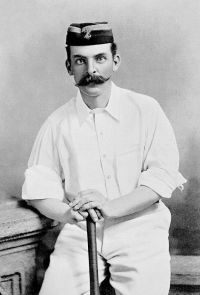 Allan Gibson Steel,
Cricket
(1888)
“ There is no greater or more successful trap for wild young players than these widish off balls. But it is indeed a trying time for the bowler when he keeps pitching just outside the off stump, and is not even played at by the batsman. Bowlers should, in these circumstances, bowl ball after ball on the off stump and just outside it. It is by no means an uncommon occurrence to see these punishing batsmen taken in by a ball that comes in a little with the arm, and removes the bail while they are striking an attitude, bat over shoulder. ”
Allan Gibson Steel,
Cricket
(1888)
“ The stumps are twenty-two inches in height; there is only one bail, of six inches in length. 'No ball,' as far as crossing the crease goes, is just like 'no ball' to-day. Indeed, the game was essentially the game of to-day, except that if a ball were hit 'the other player may place his body anywhere within the swing of his bat, so as to hinder the bowler from catching her, but he must neither strike at her nor touch her with his hands.' At this moment of legislation, when the dim heroic age of cricket begins to broaden into the boundless day of history, Mr. ”
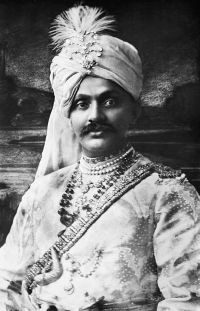 Ranjitsinhji Vibhaji II,
The Jubilee Book of Cricket
(1897)
“ It is a mistake to suppose that whatever is not forbidden in written laws may be done without self-condemnation. Nor does it follow that what is felt to be contrary to the advantage of cricket ought to be made matter of legislation. If good cricket consists in batting as well as you can, and bowling as well as you can, then, in the interests of the game, the Oxford men in 1893 had no business to bat badly in order to follow on, and the Cambridge men in 1893 and in 1896 had no business to bowl badly to prevent them, whether it was in the written laws of cricket or not. ”
Robert Henry Lyttelton, Out-door Games: Cricket and Golf (1901)
“ It seems to me that the broad interests of the game are being overlooked owing to the great preponderance of the batsmen over the bowlers. Batsmen as a class seem to be against any alteration of the law which would tend to diminish the run-getting. This question of throwing is one symptom, the refusal of the captains to sanction any alteration of the rules respecting leg before wicket is another, and speaking generally, the agitation against excessive run-getting and drawn matches seem to arise and be carried on by those whom I will call the enlightened section of the public. ”
Ranjitsinhji Vibhaji II,
The Jubilee Book of Cricket
(1897)
“ Before a match a bowler ought to go and look at the pitch in order to find out all about it. He is justified in taking advantage not only of the state of the wicket, but of trees or houses that may happen to be behind his arm and obscure his delivery. Any unfair device is, of course, to be condemned—such, for instance, as a needlessly flapping sleeve, intended to distract or annoy the batsman. ”
Allan Gibson Steel,
Cricket
(1888)
“ If an 'Anti-Throwing Society' could be established amongst cricketers, we firmly believe it would effect its object. In the North of England, where the game is ever increasingly popular, there are many 'chuckers' to be met with. The clubs who do not possess, to say the least, a doubtful bowler are, we should say from our experience, in the minority. Young professional bowlers see the general laxity that prevails, and adopt the peculiar flick of the wrist and elbow, hoping thereby to get more twist on the ball, and this sooner or later develops into a throw. ”
Allan Gibson Steel,
Cricket
(1888)
“ We do not mean that everybody ought always to throw at the wicket, but only that some fields, under certain circumstances, ought to do so. These circumstances occur when it is the only chance of running a man out. The ball should be hurled violently at the bails, and if an overthrow occurs, the wise captain will abuse those who ought to be backing up, and not the thrower. ”
James Pycroft, The Cricket Field (1854)
“ The better the bowler, as we have already explained, the more horizontal and the fairer his delivery. Cobett and Hillyer have eminently exemplified this principle; but amongst amateurs and all but the most practised bowlers, allowing, of course, for some exceptions, the law is habitually infringed. In a country match a strict umpire would often cry "no ball" to the bowlers on both sides, cramp their action, produce wide balls and loose bowling, and eventually, not to spoil the day's sport, the two parties would come to a compromise. ”
Allan Gibson Steel,
Cricket
(1888)
“ Should he stand behind and take the ball before it reaches the wicket, there is great danger of his disarranging the bails before he gets the ball in his hands. Of course there are exceptions to this rule—e.g. when a ball is coming very slowly up to the wicket from a feeble throw or because the ground is sticky and dead; then the bowler must do his best anyhow to get the ball into the stumps before the batsman reaches the crease. A bowler should never throw the ball at the wicket unless it is the only possible chance of running the batsman out. ”
Ranjitsinhji Vibhaji II,
The Jubilee Book of Cricket
(1897)
“ But a batsman has no right to risk his own or his partner's wicket for the sake of one run. The institution of talent-money has cost many a professional his wicket in county cricket. Most counties give their representatives a sovereign for every 50 runs they make. Naturally this makes them all the more anxious when they approach the required totals. That sovereign causes innumerable run-outs and rash strokes. It should be remembered that the sacrifice of one wicket may mean the loss of a match, and no one has a right to risk the match even to get a sovereign. ”
James Pycroft, The Cricket Field (1854)
“ We extract the following:— "The judge of the Brentford County Court has decided that cricket is a legal game, so as to render the stakeholder liable in an action for the recovery of the stakes, in a case where one of the parties had refused to play." Cricket is not solely a game of skill—chance has sway enough to leave the vanquished an if and a but. A long innings bespeaks good play; but "out the first ball" is no disgrace. A game, to be really a game, really playful, should admit of chance as well as skill. ”
Robert Henry Lyttelton, Out-door Games: Cricket and Golf (1901)
“ Why not allow all bowling, unless there can be no possible doubt that it is throwing, for slow and medium pace bowlers? Whilst in the case of very fast bowling, seeing that a throw under these circumstances would be dangerous, let the benefit of the doubt be the other way, and "no-ball" every doubtful delivery. Why is throwing not allowed, and why was the rule originally passed that the ball must not be thrown or jerked? Because in the days of rough cricket to throw would have been dangerous to the batsman. It would be dangerous still, though the cricket grounds are so smooth. ”
 H. G. Wells,
The Works of H. G. Wells
(1924)
“ My cricketer waves the hens aside, and revenges himself, touching his hat at intervals, by some offensively obvious remarks—as to a mere beginner—about playing with a straight bat. And the field sniggers none too furtively. I sympathise with his malice. Cricket is an altogether too sacred thing to him to be tampered with on merely religious grounds. However, our vicar gets himself caught at the first opportunity, and so being removed from my veteran's immediate environment to their common satisfaction, the due ritual of the great game is resumed. ”
Allan Gibson Steel,
Cricket
(1888)
“ Many hundreds of times has a batsman standing in his ground prevented a wicket-keeper from catching him out; the mere fact that the player's body, being in a certain position, forces the wicket-keeper to run round him instead of straight at the ball will make an uppish ball as unreachable as the sun. The fieldsman is obstructed, but not wilfully, so no penalty is incurred. But if the batsman were to hit up a ball to point, for instance, and either strike at the ball with his bat or wilfully baulk the fieldsman in any way, he would be out, and deservedly so. ”
Ranjitsinhji Vibhaji II,
The Jubilee Book of Cricket
(1897)
“ If the umpires cannot be got to act on the laws, the only way to eradicate the evil, such as it is, is for every influential cricketer to tell boys and young players directly he sees anything suspicious in their actions, and to discourage generally all doubtful deliveries. If once the right opinion could be widely established, captains would be careful not to use any bowler whose delivery could raise any doubts of any kind whatever. For some reason the Australian conscience is more tender than ours upon this question of cricket morality. ”
Allan Gibson Steel,
Cricket
(1888)
“ If a batsman considers he has been given out wrongfully, he has a perfect right, of course, to give his opinion of what has taken place privately to anyone; but he has no right to stand at his wicket wrangling with and abusing the umpire, nor has he a right to declare publicly to the pavilion on his return from the wickets that a wrong decision has been given. ”
James Pycroft, The Cricket Field (1854)
“ All this is trying; but since it is always happening, an "inseparable accident" of the game, it is time that an unruffled temper should be held the "differentia" of the true cricketer and bad temper voted bad play. Eleven good-tempered men, other points equal, would beat eleven sulky or eleven irritable gentlemen out of the field. The hurling of bats and angry ebullitions show inexperience in the game and its chances; as if any man in England could always catch, or stop, or score. This very uncertainty gives the game its interest. If Pilch or Parr were sure of runs, who would care to play? ”
Allan Gibson Steel,
Cricket
(1888)
“ Then the bowlers and fielders are nerved to their utmost endeavour to keep the runs down, every fielder runs after the ball at the very top of his speed, half-a-dozen men are backing up to prevent an overthrow, and the bowler not only does all he knows to secure a wicket, but strives hard to avoid the delivery of a punishable ball. Whenever a side goes in for the last innings of the match against a big score and wins, one may feel sure the match has been won by sound and sterling cricket. ”
Allan Gibson Steel,
Cricket
(1888)
“ Knight's proposed law ran, 'The ball shall be bowled; if it be thrown or jerked, or if any part of the hand or arm be above the shoulder at the time of delivery, the umpire shall call No Ball.' In one of the trial matches (Sept. 1827) it is said that Mr. Knight, Broadbridge, and Lillywhite, all bowled high over the shoulder. There are no wides in the score. When a man was caught, the bowler's name was not given. Lillywhite has thus no wicket to his name. ”
Allan Gibson Steel,
Cricket
(1888)
“ But it is difficult for anybody to explain, except on the ground of gross carelessness, how a man who is a good bat or bowler can be so utterly useless as a field as some have turned out to be. The cricketer who never appears to have grasped the rudiments of the laws concerning twist, who is lazy and will not run after the ball, and who hardly by accident holds a catch, is an eyesore in cricket. ”
Ranjitsinhji Vibhaji II,
The Jubilee Book of Cricket
(1897)
“ There are no definitions in the 'Laws of Cricket' of either bowling or jerking or throwing. It is presupposed that all umpires know that a ball must, in being propelled, be either bowled or not. The Laws direct an umpire to call "No ball" whenever he sees a ball so propelled that any question arises in his mind as to whether it is bowled or not. What could be more simple? And yet ninety-nine umpires out of a hundred entirely misunderstand their duty on the point. Nothing will make them "no-ball" a bowler until they are absolutely satisfied that he is throwing or jerking. ”
Allan Gibson Steel,
Cricket
(1888)
“ The trap laid for the batsman in this style of bowling is the danger he incurs by hitting unless he is actually on the pitch of the ball; if he falls into the snare, the ball is perfectly certain to go up in the air, and generally in the direction of cover-point or mid-off. This, of course, is owing to the twist of the ball causing it to hit the side and not the centre of the bat. Should the batsman in the act of hitting miss the ball altogether, as is not infrequently the case, he pays the penalty of being stumped unless he happens to be a fast-footed hitter. ”
Cricket (1903)
“ It is not to be supposed that even we, for all our legislation, have witnessed the final evolution of cricket. Legislate we never so often, something will always remain to be bettered—the width of the wicket or the law of the follow on. About the earliest records that have come down to us there is a notable incompleteness that we must certainly regret. The bowler gets no credit for wickets caught or stumped off his bowling. ”
Allan Gibson Steel,
Cricket
(1888)
“ A bowler should do all in his power to prevent cutting up the wicket with his feet in a place where bowling from the other end may pitch. If he finds that he is doing so with either foot he should at once change sides of the wicket, and if he then finds that, do what he will, he cannot help damaging the wicket—which is a most unlikely event—he should at once desist from bowling. If the ground is unduly cut up and made artificially difficult for the batsmen by bowlers' feet, whether it is done intentionally or not, such bowling is unfair and should at once be stopped. ”
Robert Henry Lyttelton, Out-door Games: Cricket and Golf (1901)
“ Till the rules of cricket are altered by the M.C.C., no one except an umpire has the least right to lay down the law as to who bowls fairly and who does not. The County Captains have constituted themselves a sort of supreme court over the head of the M.C.C. By their action they have struck one of the hardest blows at the true interests of cricket it is possible to conceive, and have done an injury which it may be difficult to remedy. ”
 Thomas Hughes,
Tom Brown's School Days
(1868)
“ Such a catch hasn't been made in the close for years, and the cheering is maddening. "Pretty cricket," say's the Captain, throwing himself on the ground by the deserted wicket with a long breath; he feels that a crisis has passed. I wish I had space to describe the whole match; how the Captain stumped the next man off a legshooter, and bowled slow cobs to old Mr. Aislabie, who came in for the last wicket. How the Lords' men were out by half-past twelve o'clock for ninety-eight runs. ”
Allan Gibson Steel,
Cricket
(1888)
“ We hope none will think we are advocating anything at all unfair in the game, or anything that is even on the line between fairness and 'not quite straight.' As a rifle-shooter takes advantage of a lull in the wind to pull his trigger, as a deerstalker of every rock and unevenness of ground to approach his game—in short, just as in every kind of sport natural facilities may be utilised—so in bowling every peculiarity of time and place should be enlisted on the side of the bowler in his (in these days of good wickets and good batting) by no means easy task of getting rid of the batsman. ”
Related terms
Authors who wrote about “bail (cricket)”
Allan Gibson SteelRanjitsinhji Vibhaji IIRobert Henry LytteltonJ. M. GibsonJames PycroftR. H. LytteltonThomas Hughes"Alpha of the Plough"W. G. Grace Talbot Baines ReedSt. George's Cricket ClubVarious
 William George Beers
 Virginia WoolfH. G. Wells
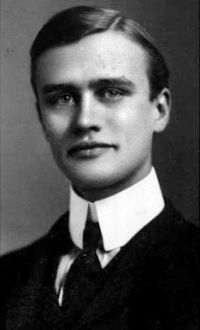 T. S. Stribling
 Jerome K. Jerome
 Arthur Quiller-Couch
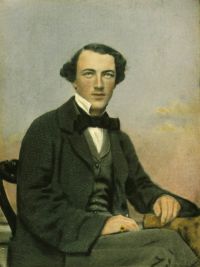 Tom Wills
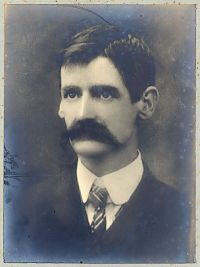 Henry Lawson
