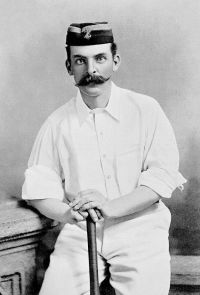
“ Often and often one sees a bowler, and perhaps one who has the name of being first-class, send down to a new batsman straight long-hops one after the other—balls which it is impossible, or nearly so, to score off, and then at the end of each over walk to his place with a thoroughly satisfied air, as if adding one more maiden over to his analysis had really helped his side on to the ultimate goal of victory. ”
R. H. Lyttelton
Biographical details
Robert Henry Lyttelton (1854–1939), an English cricketer and solicitor, is best known for his promotion of sportsmanship and reforms in cricket’s regulations. A member of a distinguished cricketing family, he played seven first-class matches in the 1870s but achieved lasting influence through his writings, particularly Cricket (1888), co-edited with A.G. Steel.
His condemnation of unsportsmanlike conduct, such as leg-blocking, and his efforts to amend the rules demonstrate a lifelong dedication to ethical play. Lyttelton’s essays, filled with technical expertise and moral insight, remain foundational works on the game’s development, combining legal rigor with a profound appreciation for cricket’s traditions. His influence persists in both the sport’s administration and its literary conversation.
Quotes by R. H. Lyttelton
“ By a bumpy wicket I do not mean a fast fiery wicket where the ball only goes over the top of the stumps and raps the knuckles occasionally, but a wicket upon which you may get a shooter one over and a blow on the chest the next, as a pleasing variety to those that come frequently right over your head the first bound and straight into the hands of the long-stop without again touching the ground. ”
“ A good cricketer who has made a bad stroke and thereby lost his wicket knows better than any spectator what a mistake he has committed. Pavilion worthies, ye who love cricket for its own sake, ye who sit for hours criticising every ball and every stroke, forbear, we pray you, out-spoken remarks on the arrival of a discomfited batsman. ‘What on earth possessed you to try to hit a straight one to leg?’ ‘You never seemed at home the whole time!’ ‘You can’t keep that leg of yours out of the way!’ are all remarks that may be withheld at any rate till the keen sense of failure has diminished. ”
“ We do not believe, though with bated breath let it be said, that the fine rider on a fine horse in a good position and over a grass country with a burning scent can feel so supremely content with the world and its glorious surroundings while galloping and jumping close to hounds, as does a batsman who feels [93] himself master of the bowling on a good wicket in a first-class match, with a fine day and a large crowd keenly anxious for his well-doing. He is conscious that his side is gaining a glorious victory by his efforts, and life can give him no prouder moments. ”
“ It has always appeared to us that the reason why real slow bowling is slightly less deadly than fast or medium on slow wickets is simply that the batsman is more at the mercy of the eccentricities of the ground when playing to the latter class of bowling than when playing to the former. He always has the power, if he would only exercise it, of leaving his ground to balls of a certain length from the slow bowler, and smothering them. And again let the beginner lay this axiom to heart: the ground can commit no devilry if the ball is smothered at the pitch. ”
“ You may go and watch a match when the ground is as hard as iron and as true as truth, and see a magnificent innings played by some batsman. The same player on a bowler’s wicket is not less uncomfortable than the proverbial fish out of water. A man may be a lion on a lawn, but a mere pigmy when the ground is not a lawn. There are a great many of these lions on lawns in these days, and to hear them all with one consent begin to make excuse when they have been bowled out on a crumbling wicket is very amusing. The ball hung, or it kept low, or ‘broke back a foot, I assure you, dear boy. ”
“ I need not say how delighted I am to watch the progress of every young and rising cricketer. My heart is in the game I love above all others, with a love that is as strong to-day as it was when I made my first large score, and when eye, hand, and foot were much quicker than they are now. I do not believe that there are no days like the good old days of cricket, [312] but I do strongly believe that the prospects of the game are as bright and hopeful to-day as they have been at any time in its history, and that in future years as great if not greater things will be done with both bat and ball. ”
“ An injudicious and talkative batsman often materially assists a bowler by such remarks as, ‘I can’t see your bowling a little bit. When tossed high in the air that beastly tree is right behind;’ or, ‘When you bowl over the wicket the ball gets right in a line with the dark windows of the pavilion, and I can’t see it at all.’ Can anyone imagine for a moment that a bowler will not do his very best instantly to make the most of the dark branches of the tree or the windows of the pavilion? ”
“ We hope none will think we are advocating anything at all unfair in the game, or anything that is even on the line between fairness and ‘not quite straight.’ As a rifle-shooter takes advantage of a lull in the wind to pull his trigger, as a deerstalker of every rock and unevenness of ground to approach his game—in short, just as in every kind of sport natural facilities may be utilised—so in bowling every peculiarity of time and place should be enlisted on the side of the bowler in his (in these days of good wickets and good batting) by no means easy task of getting rid of the batsman. ”
“ It is for the rising generation either to alter the law or to learn the art of getting in front of the wicket when the ball does not pitch straight.It is in vain to lament over long scores and unfinished matches, over dearth of bowlers and slackness in the field, whilst all the time we are doing everything we can to make matters easier and easier for the batsman, giving him perfect wickets, on which he can score 100 runs without getting out of breath, devoting his legs to the new purpose of systematically intercepting the more difficult balls. ”
“ Our wickets keep falling in this life. One after the other goes down. They are becoming few who joined in those Border matches where there was but one lady spectator, when we made such infrequent runs, and often dropped a catch, but never lost heart, never lost pleasure in the game. Some of them may read this, and remember old friends gone, old games played, old pewters drained, old pipes smoked, old stories told, remember the leg-hitting of Jack Grey, the bowling of Bill Dryden and of Clement Glassford, the sturdy defence of William Forman. ”
“ For playing ‘off breaks’ of all paces, it is a great and golden rule for batsmen to remember: Never allow space between the bat and the left leg for the ball to pass through. This rule, which insures the left leg of the batsman being placed well across the wicket when playing forward, if followed, will render it almost impossible for him to be bowled out with an ‘off break.’ It is an astounding fact that this simple rule, which should be patent to everyone, seems unknown to all our best batsmen with one or two notable exceptions. ”
“ He is continually rushing about, altering the field every over without any reason, shouting excitedly at the top of his voice whenever a fielder has to stop or throw up the ball, and generally creating a feeling of uneasiness and excitement among players and spectators. He is at one moment tearing his hair distractedly because some unfortunate fielder has let a ball through his legs, and the next shouting and dancing with excitement and joy when some exceptionally good catch or bit of fielding has got rid of a dangerous batsman. ”
“ But the change of tactics in not having a long-stop has had one effect that we regard as pernicious, and that is, that it has spoilt one part of the skill of wicket-keeping, and on the whole worked an enormous change for the worse in the fielding of short-slips generally. The long-stop is not there, both wicket-keeper and short-slip are conscious of this, and they are aware that his place must be filled up by themselves. If a ball goes in the least to leg, even if it only just misses leg-stump, short-slip is usually to be seen backing up the wicket-keeper ”
“ It is always better for a bowler to see a fresh batsman make half a dozen runs from well-pitched balls or half-volleys his first over than to see him stop four straight long-hops.On the fall of a wicket the bowler should always remember that the new batsman is entirely unaccustomed to the light and not yet warm to his work, and that consequently the pet devices which may have been clearly seen through and mercilessly punished by the retiring batsman are for the present quite fresh for the new one. ”
“ Now I come to a drying, sticky wicket. This is about the worst you can play upon, and he who scores largely on it deserves to be praised indeed. If the bowling be indifferent the player who can pull or hit a long hop to leg has a decided advantage, as the ball hangs a great deal at times and favours that kind of play. If the bowler be on the spot, then tall scoring is an impossibility. The work to be got on the ball is astounding; I have seen balls break a foot or more. ”
“ It is always best for a fast bowler to try a ball or two before beginning, excepting in circumstances when he is called upon to bowl to some one he has never bowled to before, and especially so to some one who has never seen him bowl. How often when batting have we silently chuckled with joy at seeing a man quite unknown to us rapidly loosening his arms with two or three balls before beginning to bowl! It is a great thing to have an unknown bowler on one’s side, but he loses half his value if his style and action are revealed to the batsman before he receives the ball. ”
“ Captaining a village team is not all a bed of roses; but if you are really a cricketer at heart, you will soon acquire the absolute confidence of people of all classes, especially of the humbler order. It is not an unpleasant thing, as you walk across the green on your way to the train, to hear a pack of little boys on their way to school, who look on you as a kind of big dog that won’t bite, all chattering about the match the day before. ”
“ As it is necessary for a shooter to accurately judge the pace of a driven grouse before pulling the trigger, so is it equally necessary for a batsman to judge the pace of the ball before he plays to it. ”
“ But the village umpire is, perhaps, the most interesting personage on the ground. He is usually a stout elderly man, who, grown too grey on the head and too thick in the girth to give his side any more active help in the field, assists in quite as efficient a manner in his new post. He is generally a genial, jolly sort of fellow; devoted to the game, he fondly imagines that he is an infallible judge of every point that can arise in it, though really he is wofully ignorant of the whole subject. ”
“ Perhaps the rising generation is now more quickly promoted, and better coached than of old. I feel a hesitation in offering any criticism because I had only one quality of a cricketer, enthusiasm, combined for a year or two with some twist from leg. But, if I never was anything of an expert, my heart hath always been with those old happy scenes and happy days of struggling cricket. What jolly journeys we had, driving under the triple crest of Eildon to Kelso, or down Tweed to Galashiels, or over the windy moor to Hawick! ”
“ Although ordinary fast balls are easy to play on good wickets, however, it is but seldom that a wicket which is good at the beginning of a match remains so to the close. The ground wears and cuts up with the continual pitching of the ball and the tramp of feet, and fast bowling on such occasions often becomes most deadly. Then, again, a fast quick delivery to a newcomer, even though the best of batsmen, may deceive him in the pace, and, before the eye gets accustomed to the light and the hand becomes steady, cheat him into playing back at a ball which ought to have been met with forward play. ”
“ Never do batsmen look so foolish as when they affectionately meet at the same wicket, and nothing is so maddening to the supporters of a side as to see a good batsman well set deliberately lose his wicket by the folly of either his colleague or himself. If batsmen will only remember that the decision of the run must rest with one man, and that his call must be obeyed at once, there will not be many runs out. When, say, the third run is being made, and the question whether a fourth can be successfully attempted arises, that batsman who has to run to the wicket nearest the ball ought to call. ”
“ If every batsman were perfectly accurate in his sight and judgment of pitch, every so-called ‘yorker’ would be neither more nor less than a ‘full-pitch.’ However, as every batsman, we are thankful to say, is liable to err in judging the pitch, and as nearly every batsman when first going in is more liable to err with a ‘yorker’ than any other ball, the bowler should most decidedly try it. A slow bowler should first try a medium-paced ‘yorker,’ somewhat faster than his usual pace, and then a slower one. ”
“ If we compare gentlemen bowlers of the age of nineteen with professionals of the same age, we shall find that the former have nothing to fear from the comparison. But pass on for five or six years, and the gentlemen are seen to be behind in the race for pre-eminence. Can this be the fault of public schools? Is it not rather that after leaving school few, scarcely any, systematically practise bowling, although they are just at the right age to improve, having stronger muscles and more experience, to say nothing of leisure hours and increased opportunities? ”
“ And then a captain’s eyes must be sharp to detect any slovenliness in the dress of a batsman. What a sorry sight it is to see a man going to the wickets with his pad-straps hanging two or three inches down his legs, his trousers unfolded and sticking out from behind his pads, his shirtsleeves hanging loose, and altogether having a general air of being a slovenly fellow! ”
“ For sharp catches, wicket-keeping is, perhaps, the only thing that will help. The peculiar faculty they demand is, like the spin in bowling, something that cannot be taught, the possession of which is a guarantee of genius. ”
“ The batsman feels and the wicket-keeper sees it, but none else in the field knows anything at all about what has happened. The umpire can see the ball pass very close to the glove, but whether they have actually touched he cannot at a distance of twenty-four or twenty-five yards decide. An umpire may often be deceived, too, in his vision, if the ball pass the bat quickly and the stroke of the bat towards the ball has been a rapid one; he may hear an ominous ‘click’ that sounds like a touch, and yet he may think that he saw daylight between them at the moment the ball passed the bat. ”
“ The very fast-footed bookish sort of player is the one who is most at sea on soft wickets; and this last bit of advice we respectfully urge upon him—that one hit for four and out next ball will probably be of more value to his side than twenty minutes’ careful defence and no run. It is not on soft wickets that drawn games are played, unless there is rain after the match has begun; it is on dry wickets, with boundaries close in, that the plethora of runs makes the game dull to all except the ignorant spectator and the voracious batsman. ”
“ Imagine what it would be if Bonnor, or Forbes, or Game were to be allowed to throw, all of them having thrown in their best days as much as 120 yards—is it likely that a batsman at a distance of only twenty-one yards could be quick enough with his bat to stop such bowling? Even with an ordinary fast bowler a batsman has sometimes difficulty in preventing himself from being struck by the ball, and with an undisguised thrower the danger would be tenfold. ”
“ Batting may be called the most enjoyable feature of the great and glorious game of cricket. A man even in full training invariably feels the effect of fatigue after bowling sixty or seventy overs, and fieldsmen go through the same experience during a long outing. But it may with truth be said that the keen pleasure which is realised by every cricketer worthy of the name, while he is actually at the wickets, prevents him from feeling fatigue as an inconvenience until the innings is over. ”
“ When a slow or medium-pace bowler wishes to deceive the batsman by a change of pace, he has, of course, two courses open to him—either to accelerate the speed of the ball or diminish it. When he wishes to bowl a faster ball than usual, he must remember that the object of the experiment is to make the batsman play slower to the ball than he has been doing, and that this result will be far more easily accomplished by pitching a good-length—if anything, a little further than a good-length—ball, than by a short one. ”
“ They have less waiting for their innings, and consequently less of that restless nervousness from which few men are free; they have the best of the wicket; they have often loosish bowling just at first, before the bowlers have warmed to their work; and, last but certainly not least, they are batting a new ball. Few people realise what a difference a new ball makes to the batsman; it goes cleaner and firmer off the bat than an old one, and, what is better than all, a hard new ball is much more difficult to twist than one that has had a hundred runs made off it. ”
“ The body of the batsman in many cases completely obstructs the view the wicket-keeper ought to have of the ball. Even if he can get a good sight of the ball there is that abominable bat [255] being fiddled about, baulking the eyesight in the most tantalising manner, and there are some batsmen who have a provoking habit of waving their bats directly the bowler begins his run, and continuing their antics till the ball is right up to them; while others seem to be built like windmills, and have a limb always at hand to throw out between the unhappy wicket-keeper and the rapidly-advancing ball. ”
“ In Melbourne, Sydney, and Adelaide, the chief nurseries of Australian cricket, the grounds are so excellent, and usually so hard and fast, that no bowler can possibly expect the slightest amount of success unless he possesses some peculiarity of style or action, pace or power, over the ball; mere pace and accuracy are of no avail. On the hardest and best wickets it must be laid down as an axiom that bowlers with change of pace and turn must form the bowling backbone of the future best eleven, and these qualities the young Australian cultivates with greater success than the English. ”
“ Many cricketers say, ‘Let throwers alone, they are always easy to play;’ and this, no doubt, is so, for the reasons given above, especially when every thrower must, for the sake of appearances, adopt some slight measure of disguise in his action; but once let it be recognised that throwing is part of the game, and a race of sturdy chuckers will spring up, whose pace will be so terrific that the best and pluckiest batsman will not be able to defend his body, much less his wicket, against their lightning-like deliveries. ”
“ He has put his two best bowlers on, and so long as a wicket falls every thirty or forty runs, what does it matter whether or not time is being wasted by a series of profitless short-pitched maiden overs? It is the bowler’s duty, not his, to get the batsmen out, and if the latter put on forty runs without a wicket falling, why it will be time enough then to try someone else, and perhaps later on he himself might have a turn with lobs if things get into a very bad state. ”
“ England match in 1884, when every member of the English team, including Shrewsbury, had to bowl—and then, if he fails, he has only done what was expected of him. But it is difficult for anybody to explain, except on the ground of gross carelessness, how a man who is a good bat or bowler can be so utterly useless as a field as some have turned out to be. The cricketer who never appears to have grasped the rudiments of the laws concerning twist, who is lazy and will not run after the ball, and who hardly by accident holds a catch, is an eyesore in cricket. ”
“ The great and supreme art of batting constitutes to the large majority of cricketers the most enjoyable part of the game. There are three especially delightful moments in life connected with games, and only those who have experienced all three can realise what these moments are. They are (1) the cut stroke at tennis, when the striker wins chase one and two on the floor; (2) the successful drive at golf, when the globe is despatched on a journey of 180 yards; (3) a crack to square-leg off a half-volley just outside the legs. ”
“ Besides, what sport or individual interest to a batsman is there in making runs after the match is practically finished? A man does not play at cricket for himself so much as for his side; it is not the number of individual notches or wickets that falls to his lot which delights the true cricketer: it is the actual result of ‘won or lost.’ What pleasure does a member of either of the University elevens derive from making fifty every innings he plays in the Inter-University matches if all his matches are lost? ”
“ A batsman may run himself out or put his leg in front, and nobody wonders; but if a steady bowler bowls three wides running, the most ignorant spectator sees through the game at once, and yells accordingly. The problem may be stated in another way. Is it cricket to sacrifice runs by running yourself out or knocking down your wicket? If the answer is in the affirmative, then state your reason why it is wrong for a bowler to sacrifice runs by bowling wides or no balls. To a genuine cricketer it is equally unpleasant to see cricket turned into burlesque by the batsmen as by the bowlers ”
“ The grand thing is to try and make cricket real, and to make youngsters understand that playing the strict game is the secret of true enjoyment. We all know how all pleasure depends on observance of simple rules, and on doing in practice all things as carefully as if we are engaged in a match, or any other friendly strife. Even if I play at ‘beggar your neighbour’ with a child I insist on the rigour of the game. ”
“ Chummy the sweep, a good cricketer formerly, who sits on a form just outside the tent, behind a very short pipe, are glancing round on you, what a comfort it is, if you turn round, to see an almost imperceptible nod of Mr. Chummy’s head—for he never speaks during a match—which says, ‘Going on all right—we shall win!’ That nod of the head is only intelligible to a cricketer, just as a very ‘shy’ rise of a trout is only perceptible to a genuine fisherman. ”