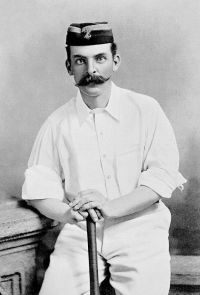
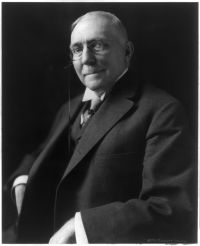
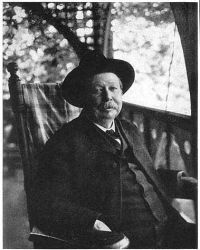
“ When one considers that the best batsman in the world is not absolutely certain of scoring a run, and that a good fieldsman nearly always saves 20 or 30, the importance of fielding can at once be appreciated.From a spectacular point of view there is no more stirring sight than to see eleven players, each of whom is striving his utmost to outdo the other in his efforts to save runs, bringing off catches that an ordinary field would not even attempt, and saving runs in a manner which at times borders on the miraculous. It is such a sight as this that saves cricket from becoming too monotonous. ”
Fielding (cricket)
Definition and stakes
Quotes about “fielding (cricket)”
Jones Wister, A "Bawl" for American Cricket
“ FIELDING. American Cricket owes a debt of gratitude to base ball. The undaunted pluck that stops and holds the fierce grounder; the strong arm which returns it to the baseman; the steady judgement that guides the out-fielder to the fly; all deserve the highest praise. Cricket welcomes the base ball fielder to the cricket ground, gives him the post of severest duty, depends upon his keen eyesight, splendid throwing, quick action and steady nerve. ”
Jones Wister, A "Bawl" for American Cricket
“ Companions can practice fielding indoors or almost anywhere, if a ball is provided. Cricketers will find a ball a delightful companion. Passing it around gives the practice which fielders must have to become expert. A dozen occasions innure the hands to the sensation of stopping a fast ball. It will no longer feel hard, but the fielder will take it at lightning speed. Perfect fielding is absolutely unknown on the American cricket fields. Errors are so numerous even among the best players, that bowlers lose courage and nerve. Each fielder should recollect that he is the support of the bowler. ”
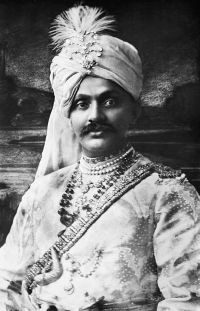
The Cricket of Abel, Hirst, and Shrewsbury
“ Similarly, in fielding, Cricket suffers from many ignorances and negligences. Not only is there the general idea that fielding is unimportant compared with batting and bowling, but it is assumed that it can be got {221}through somehow without practice or apprenticeship. The mere art of patient yet expectant waiting for an opportunity is in itself almost as difficult to acquire as it is worth acquiring. Mere safety in stopping balls, or even in catching balls, is often considered the acme of excellence, whereas the anticipation is not less essential. ”
Ranjitsinhji Vibhaji II,
The Jubilee Book of Cricket
(1897)
“ Fielding is a department of the game much neglected at the Public Schools, more at the Universities, and more still in county cricket. As for ordinary club matches, fielding is regarded as a necessary evil which must be tolerated, because without it batting and bowling are impossible. And yet for winning matches, fielding is not a jot less important than batting and bowling. ”
Cricket (1903)
“ Ground fielding has been brought to a state of perfection for which the improvement in the modern cricket-grounds is in a large manner responsible. To become a good ground fieldsman one must be able to judge the pace of the ball to a nicety; otherwise, although one may succeed in stopping it, one will fail to gather the ball accurately, and consequently will not save the run. The fieldsman who excels is the one who, gathering the ball accurately, returns it to the keeper or bowler with one and the same action. ”
Allan Gibson Steel,
Cricket
(1888)
“ Nothing can look much worse in the cricket field than to see fieldsmen with their hands in their pockets, and it is certainly not conducive to quick, smart fielding. I have observed that nearly all good fielders keep their hands hanging loosely by their sides, and are ready to dash after the ball immediately it is hit anywhere in their direction. Be sure to try on every new pair of trousers when sent home from the tailor's, or you may find out when too late to rectify the mistake that they are either too small or too large, and are completely useless. ”
Jones Wister, A "Bawl" for American Cricket
“ If the fielder waits for notification to receive and return the ball he will in ninety-nine cases out of every hundred belong to the bump on the log variety. Fielding should be practiced whenever cricketers meet on the turf. Many captains advocate meeting for fielding only. In view of the numerous occasions for practice which constantly present themselves it seems to the writer unnecessary. But these must be used. The hardness of the cricket ball causes fear to the unpracticed. It hurts tender hands to be rudely struck by the hard ball. ”
Ranjitsinhji Vibhaji II,
The Jubilee Book of Cricket
(1897)
“ The cricketer, if he can be called one, who does not care for fielding, and who only plays for the sake of enjoying batting and bowling, is a very poor sportsman indeed. Fielding is the only branch of the game in which, if one tries hard enough, one can be sure of success. A batsman may get bowled first ball, a bowler may be quilted all over the field without getting a wicket, but both can redeem themselves by good fielding, which is enough by itself to render a man worth his place on a side. A bad field is an eyesore to spectators and a millstone round the neck of his side. ”
James Pycroft, The Cricket Field (1854)
“ Fielding, I fear, is retrograding: a good general player, famed for that quick return which runs the adversary out, one who is, at the same time, a useful change in bowling, a safe judge of a run, and respectable at every point of the game—this is becoming a scarce character, and Batting is a word supposed co-extensive with Cricket,—a sad mistake. Spare the bowler.—One reason for returning the ball not to bowler, but to wicket-keeper, who should advance quietly, like Box, and return a catch. ”
Allan Gibson Steel,
Cricket
(1888)
“ Mynn's analysis gave 52/5 a wicket. His average was but 17 an innings. Scores were shorter fifty years ago. [29] My attempt has been to trace the streams of tendency in cricket rather than to produce a chronicle—a work which would require a volume to itself. Nothing has been said about fielding; because, however the ball is bowled, and however hit, the tasks of catching it, stopping it, and returning it with speed have always been the same. True, different styles of batting and bowling require alterations in the position of the fielders. ”
Ranjitsinhji Vibhaji II,
The Jubilee Book of Cricket
(1897)
“ As to the importance of good fielding, it is easy to prove it. Each catch that is missed simply adds another batsman to the opposing side. If five catches are dropped, the side that drops them has to all intents and purposes fifteen men to dispose of instead of ten; and each man who thus receives a second innings starts with the advantage of having more or less got used to the light and the state of the wicket. Again, let us suppose that each man on a side gives away in each innings 3 runs which he might have saved by a little more dash and alertness. ”
Allan Gibson Steel,
Cricket
(1888)
“ He is continually rushing about, altering the field every over without any reason, shouting excitedly at the top of his voice whenever a fielder has to stop or throw up the ball, and generally creating a feeling of uneasiness and excitement among players and spectators. He is at one moment tearing his hair distractedly because some unfortunate fielder has let a ball through his legs, and the next shouting and dancing with excitement and joy when some exceptionally good catch or bit of fielding has got rid of a dangerous batsman. ”
Ranjitsinhji Vibhaji II,
The Jubilee Book of Cricket
(1897)
“ The "safe" fieldsman does what can reasonably be expected of a fielder, and no more—not because he does not care to exceed that limitation, but because he cannot. Such "safe" fields can, however, be made of considerable use to a side, if they assiduously practise catching, picking up, and throwing, and, above all, during actual matches stand always on the alert. In fielding, just as much as in the other parts of the game, great success is the result of experience and practice in addition to gifts of nature. ”
Allan Gibson Steel,
Cricket
(1888)
“ Occasionally it is useful to throw to the bowler, assuming that he is behind the stumps and that mid-off is backing up, because the batsmen get frightened at this manoeuvre, and feel that their second run entails too much of a risk, and this frequently prevents them trying it again. Bear in mind that the aim of good fielding is, not to run men out, but to prevent their trying to run. Remember also that a catch to long-leg has a tendency to curl towards your right hand, so do not rush too violently towards the left directly the ball is hit. ”
Ranjitsinhji Vibhaji II,
The Jubilee Book of Cricket
(1897)
“ In the intervals of these overs the resting bowler could do a little fielding, and both he and the batsman would be gaining some practical experience of cricket under conditions approximating to those of a regular match. Moreover, it is a mistake to lay aside the small bat, small ball, and short pitch too soon, as for every purpose of the game—batting, bowling, and fielding—they are far superior to the full-sized article until a boy has come to something like fair strength. ”
Ranjitsinhji Vibhaji II,
The Jubilee Book of Cricket
(1897)
“ Even from the point of view of personal pleasure, it is worth while to cultivate an interest in fielding, and to take pains to become good at it. What a man can do well, he likes doing. Batting and bowling occasionally cause a cricketer some disappointment. Fielding is a certainty. Once make yourself a good field, once learn to take a pleasure in fielding for its own sake, and every match must provide you with plenty of enjoyment, whether or not you get runs or wickets. If people would only recognise the importance of fielding, the standard would soon be raised all round. ”
Adrian C. Anson, A Ball Player's Career
“ Secondly, the splendid display of fielding exhibited by the American ball players has opened the eyes of English cricketers to the important fact that in their efforts to equalize the attack and defense in their national game of cricket, in which they have looked only to certain modifications of the rules governing bowling and batting, they have entirely ignored the important element of the game, viz., fielding ”
Adrian C. Anson, A Ball Player's Career
“ But, moreover, they have shown by this self-same fielding skill that the game of base-ball is a better school for fielding than cricket, the peculiarity of the play in the former game requiring a prompter return of the ball from the outfield, swifter and more accurate throwing, and surer catching than the ordinary practice of cricket would seem to need. ”
Allan Gibson Steel,
Cricket
(1888)
“ Slow fields are earnestly advised to practise throwing; for their defects are less apparent when fielding a long distance from the wicket, and the non-observant spectator does not notice that the ground covered at a distance from the wicket by a slow field is very small compared to that commanded by some space-covering field like Gunn, Maurice Read, and Stoddart. ”
Ranjitsinhji Vibhaji II,
The Jubilee Book of Cricket
(1897)
“ One hint worth remembering in catching, and in a less degree in fielding, is, as we said before on page 17, to let the hands give as the ball enters them, so that the resistance is less. It is a mistake to hold the arms and hands stiff. It only encourages the ball to bounce out. Besides, if the ball is hit hard and meets with a pair of unrelenting hands, it usually hurts them. Some misguided fielders go one better than fixity. They seem to grab at the ball as one would catch flies, or hit at it as one would at a fives-ball. ”
Jones Wister, A "Bawl" for American Cricket
“ The courage and nerve which are sure to follow careful training and good discipline, can and will prepare each batter to depend upon himself, rather than follow a bad example. Fielding is too much neglected for the more pleasant occupation of batting. The net is a useful invention, a tremendous time saver, thoroughly in accord with other economic devices of the age, but it has not improved fielding. Fielders should practice their art when the game is not in progress if they expect success while the eyes of spectators are concentrated upon a hard hit ball. ”
James Pycroft, The Cricket Field (1854)
“ A fast runner nascitur non fit: still, practice does much, and especially for all the purposes of a fieldsman near the wicket. A spring and quick start are things to learn; and that, both right and left: few men spring equally well with both feet. Anticipating the ball, and getting the momentum on the proper side, is everything in fielding; and practice will enable a man to get his proper footing and quick shifting step. A good cricketer, like a good skater, must have free use of both feet: and of course a fine fieldsman must catch with both hands. ”
James Pycroft, The Cricket Field (1854)
“ Any good fieldsman will explain, far better than our pen, the art of picking up a ball in the only position consistent with a quick return. A good throw often runs a man out; an advantage very rarely gained without something superior in fielding. Young players should practise throwing, and remember never to throw in a long hop when they can throw to the hands. "Many a 'run out,'" says Mr. R. T. King, "has been lost by that injudicious practice of throwing long hops to the wicket-keeper, instead of straight, and, when necessary, hard, to his hands;" ”
James Pycroft, The Cricket Field (1854)
“ As to form, dropping on one knee is a bad position for any fielding: you are fixed and left behind by any sudden turn of the ball. The best rule is to watch the ball from the bowler's hand and move accordingly, and you will soon find for how much bias to allow; and beware of a slope like Lord's: it causes a greater deviation than you would imagine in thirty yards. Just as the ball comes, draw yourself up heels together (thus many a shooter have I stopped) , and, picking as neatly as you can, pitch it back to wicket-keeper as if it were red hot. ”
Ranjitsinhji Vibhaji II,
The Jubilee Book of Cricket
(1897)
“ Strictly speaking, the term apphes to the gathering up of a ball so hit that it rolls along the ground till the fieldsman intercepts its course. But it is also used to denote the fielding of any ball that is not a catch. The action of fielding the ball, whether bounding or on the ground, is much the same, except that the hands in the former case do not touch the ground when the ball is received into them. ”
Ranjitsinhji Vibhaji II,
The Jubilee Book of Cricket
(1897)
“ He should be continually on his toes, ready to start forwards or indeed in any direction. After a certain amount of practice he can pick up as accurately on the move as if he were standing still. The actual method of gathering up the ball is the same as when he stands where he is and waits for it. There are many ways of practising fielding. Even two men can do a good deal together if they take it in turn to hit and to field. It is an excellent arrangement for a number of men or boys to scatter in a rough semicircle while another is hitting catches and ground balls to them. ”
James Pycroft, The Cricket Field (1854)
“ Good runners ought to cross if the ball is in the least fumbled; but clean fielding, with quick under-hand return, would beat the Regent Street Pet himself, did he attempt a run. Long-stop is wholly at fault if he requires the wicket-keeper to stand aside: this would spoil the stumping. As to gloves and pads, let every one please himself; we must choose between gloves and sore hands; but wrist gauntlets are of great use, and no hindrance to catches, which often come spinning to the long-stop, and otherwise difficult. ”
Ranjitsinhji Vibhaji II,
The Jubilee Book of Cricket
(1897)
“ The truth is, that fielding can be scamped to a certain point without retribution falling upon the sinner. From every point of view it is a pity that a higher standard is not somehow established and exacted. Before taking the various parts of fielding in detail, it may be well to say just a few words about the system of cricket management in English schools. At nearly all the larger schools it is nominally in the hands of the boys. The head-master, of course, reserves to himself the right of interfering in any way he may think proper. ”
Allan Gibson Steel,
Cricket
(1888)
“ But though the ball is on the leg side, it is quite possible for the batsman to hit it on the on side, and send it straight to short-slip's hands, if he only could have been in his proper place. He is abused if he does not back up the wicket-keeper, and in any case the mere feeling that runs must result from the wicket-keeper not handling the ball makes it impossible for him to give his undivided attention to fielding at short-slip proper. He is continually shifting towards his left hand, and numerous balls that he would have fielded if only there had been a long-stop, now result in runs. ”