“ One moment she had been laughing, free from care, the next she had looked up in the midst of some careless banter to see Philip—but what a different Philip, cold and callous and hard! Stella did not doubt Maud's version of the conversation that had passed between the two. It seemed clear enough that Philip shrank from renewal of the past, and was it any wonder? She tried to be just to him, yet a feeling of bitter resentment fought with her sense of fair play. Why, when she had discovered that, given the opportunity, life could be enjoyed, should he have come to disturb and distress her? ”
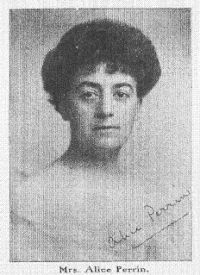
Alice Perrin
Biographical details
.jpg)
Alice Perrin (1867–1934), a British novelist, examined the lives of Britons in colonial India through seventeen novels, merging social critique with supernatural elements. Her early works, Into Temptation (1894) and Late in Life (1896), established her reputation, while East of Suez (1901)—a collection of ghost stories—garnered widespread acclaim, drawing comparisons to Rudyard Kipling.
Themes of missionary efforts, cultural conflict, and gender roles run throughout her body of work, illustrated in Idolatry (1909) and The Woman in the Bazaar (1914). Perrin’s refined depiction of colonial life, combined with her skill in genre writing, solidifies her as a notable voice in early 20th-century British literature on India.
Quotes by Alice Perrin
 Alice Perrin,
The Woman in the Bazaar
Alice Perrin,
The Woman in the Bazaar
“ Oblivious to it all, Coventry lit a cigarette and stared out at the dry compound. He was reflecting that he ought not to have married again at his age and with his temperament--or that at least he should have chosen a sedate and serious spinster, if not some gentle widow, who would have caused him no anxiety, no heart disturbance, as did Trixie--one whom he could have left without a qualm for any call of pleasure or of duty. And Trixie was to be pitied. She might have been far happier with a young husband as gay and heedless, and as irresponsible, as herself. ”
“ What devilish fate had taken him to Rassih! Yet he had a feeling that in any case he and Stella must ultimately have met, and that some day, somehow, they must meet again. The refrain of a cheaply sentimental little ballad he had heard her sing came back to him: "Some day, some day, some day, I shall meet you"—he could almost hear the clear, chorister-like voice.... Of a certainty the day would come, and then? He smiled with a sweet bitterness as he recalled her faith in his work, in his usefulness to India; she had said: "Without men like you the wheel would not go round." ”
