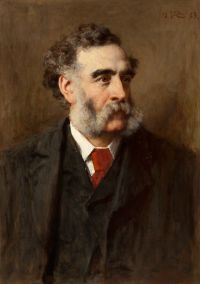
Frank Evers Beddard and Arthur Everett Shipley

Biographical details

Frank Evers Beddard and Arthur Everett Shipley 1911 Encyclopædia Britannica (1911)

It is now held that the parasite enters the blood of man through the piercing mouth-parts at the time of biting. When first sucked up by the insect from an infected man it passes into its stomach, and thence makes its way into the thoracic muscles, and there for some time it grows. Next the larvae make their way into the connective tissue in the pro-thorax, and ultimately bore a channel into the base of the piercing apparatus and come to rest between the hypopharynx and the labium.
Source: Wikisource

Frank Evers Beddard and Arthur Everett Shipley 1911 Encyclopædia Britannica (1911)

These free-living forms are found everywhere—in salt and fresh water, in damp earth and moss, and among decaying substances; they are always minute in size, and like many other lower forms of life, are capable of retaining their vitality for a long period even when dried, which accounts for their wide distribution; this faculty is also possessed by certain of the parasitic Nematodes, especially by those which lead a free existence during a part of their life-cycle. The free living differ from the majority of the parasitic forms in undergoing no metamorphosis
Source: Wikisource

Frank Evers Beddard and Arthur Everett Shipley 1911 Encyclopædia Britannica (1911)

In cultures of the latter there occur very rare supplemental males which appear in no sense degenerate but as fit for reproduction as the males of the bisexual species. Though possessing a complete copulatory apparatus and producing large quantities of spermatozoa, they have lost their sexual instinct and play no part in the economy of the species. These “psychically decadent” individuals appear to represent the entire male sex of a bisexual species, and become unnecessary owing to the grafting of hermaphroditism on the female sex.
Source: Wikisource

Get perspective with Kwize: daily news enlightened by great literature