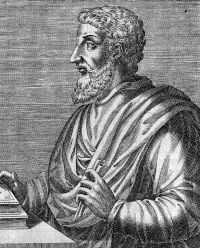
Marcus Terentius Varro

Biographical details

Portrait of Marcus Terentius Varro Marcus Terentius Varro Res Rusticae (Country Matters)

For I raise my asses, which bring such fancy prices, at the cost of one servant, a little barley and the water which springs from my land, while Hortensius must needs maintain a fleet of fishermen to keep him supplied with small fry to feed to his fish, or, when the sea runs high and such deep sea forage is cut off by a storm, and it is not possible even to draw live bait ashore in a net, he is fain to buy in the market for the delectation of the denizens of his ponds the very salt fish which is the food of the people.
Source: Wikisource

Portrait of Marcus Terentius Varro Marcus Terentius Varro Res Rusticae (Country Matters)

Bees are not of a solitary habit like eagles, but are of a social nature, like men, a characteristic they share with daws, but not for the same reason, for bees live in colonies, the better to work and build, while daws congregate for gossip. Thus the life of a bee is one of intelligence and art, for man has learned from them to manufacture, to build, and to store his food: three occupations which are not the same but are diverse in their nature, for it is one thing to provide food, another to manufacture wax and honey, and still another to build a house.
Source: Wikisource

Portrait of Marcus Terentius Varro Marcus Terentius Varro Res Rusticae (Country Matters)

During the great plague, Hippocrates the physician saved not merely one farm but many cities because he knew this. But why should I summon him as a witness: for when the army and the fleet lay at Corcyra and all the houses were crowded with the sick and dying, did not our Varro here contrive to open new windows to the healthy North wind and close those which gave entrance to the infected breezes of the South, to change doors and to do other such things, and so succeed in restoring his comrades safe and sound to their native land?
Source: Wikisource

Get perspective with Kwize: daily news enlightened by great literature