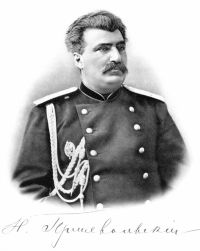
Nikolay Przhevalsky

Biographical details

Portrait of Nikolay Przhevalsky Nikolay Przhevalsky,  From Kulja, across the Tian Shan to Lob-Nor (1879)

“ After the wearisome monotony of the Tarim valley and its adjacent desert, the traveller greets with pleasure this range, which gradually grows more distinct at the end of each successive march. Not only are the peaks distinguishable, but the principal ravines may also be traced, and an experienced eye can even from a great distance detect their relative height to be very considerable. On arriving at Chargalyk the Altyn-tagh appeared to us like a huge rampart towering up even higher towards the south-west, where it exceeded the limit of the perpetual snow line. ”
Source: Wikisource

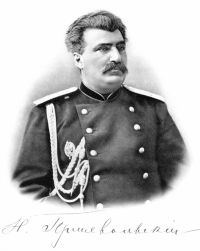
Portrait of Nikolay Przhevalsky Nikolay Przhevalsky,  Mongolia, the Tangut country, and the solitudes of northern Tibet (1876)

“ Within the last ten years the exploration of High Asia which, on our side at least, had long been languid, has revived and advanced with ample strides. So rapid, indeed, has been the aggression upon the limits of the Unknown that in the contemplation of a future historian of geographical discovery it may easily seem that the contraction of those limits in our age might fitly be compared to the rapid evaporation of the cloud with which the breath has tinged a plate of polished steel. ”
Source: Wikisource

Portrait of Nikolay Przhevalsky Nikolay Przhevalsky,  From Kulja, across the Tian Shan to Lob-Nor (1879)

“ But cheerless as these woods are, the neighbouring desert is even more dreary. Nothing can exceed the monotony of the scenery. Whichever way you turn, an ill-favoured plain meets your eye, covered with what seem to be large mounds, but which are really hillocks of clay surmounted by tamarisk, between which the path winds, every surrounding object shut out from sight, and even the distant hills barely visible in blue outline through the dusty vapour which fills the atmosphere like fog. ”
Source: Wikisource

Get perspective with Kwize: daily news enlightened by great literature