Summary

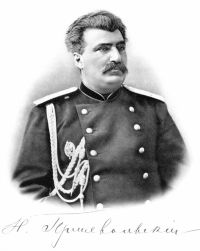
Portrait of Nikolay Przhevalsky Nikolay Przhevalsky Mongolia, the Tangut country, and the solitudes of northern Tibet (1876)

Within the last ten years the exploration of High Asia which, on our side at least, had long been languid, has revived and advanced with ample strides. So rapid, indeed, has been the aggression upon the limits of the Unknown that in the contemplation of a future historian of geographical discovery it may easily seem that the contraction of those limits in our age might fitly be compared to the rapid evaporation of the cloud with which the breath has tinged a plate of polished steel.
Source: Wikisource

Portrait of Nikolay Przhevalsky Nikolay Przhevalsky Mongolia, the Tangut country, and the solitudes of northern Tibet (1876)

Huc's is the painting of a clever, perhaps too clever, artist, but still coloured from nature. Artist he is indeed, and as far as may be from science, but, after reading Prejevalsky's narrative, I have felt, more than ever before, the charm of Huc's vivacious touches; more than ever, because the perusal of the Russian work convinced me that his pictures (I do not refer to the braggadocio, probably imaginary, of his conduct before Chinese officials) are true as well as clever.
Source: Wikisource

Portrait of Nikolay Przhevalsky Nikolay Przhevalsky Mongolia, the Tangut country, and the solitudes of northern Tibet (1876)

Shaw and Hayward and Johnson were the pioneers of British exploration in Eastern Turkestan; and these have been followed by the less perilous journeys of Sir D. Forsyth and his companions, by the ride of the latter across Pamir, and by their success in connecting, at least by preliminary survey, our own scientific frontier with that of Russia. Cooper's two daring attempts to traverse the formidable barriers which man, even more than nature, has set between India and China, are hardly within the field that we are contemplating.
Source: Wikisource

Get perspective with Kwize: daily news enlightened by great literature