“ Hugo lay on his bed, more ecstatic than he had ever been in his life. By and by he slept. Then, as if the ghosts of Uctotol had risen, his mind was troubled by a host, a pageant of dreams. He turned in his sleep, rending his blankets. He moaned and mumbled. When he woke, he understood that his soul had undergone another of its diametric inversions. The mad fancies of the night before had died and memory could not rekindle them. Little dreads had goaded away their brightness. Conscience was bickering inside him. Humanity was content; it would hate his new race. ”
Philip Wylie
Biographical details
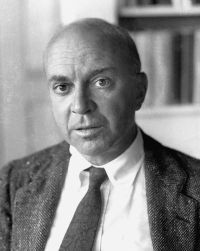
.jpg)
Philip Gordon Wylie (1902–1971) was an American writer whose diverse body of work spanned science fiction, social critique, and ecological warnings. Known for Gladiator, which may have inspired Superman, and When Worlds Collide, influencing Flash Gordon, his works examined gender dynamics, nuclear threats, and environmental collapse.
A prolific author and editor, Wylie also advised on atomic energy, merging scientific precision with philosophical exploration. His novels, such as The Disappearance and Tomorrow!, questioned societal norms and the dangers of technological overreach, leaving a legacy of sharp commentary on humanity's course.
Quotes by Philip Wylie
“ But now, knowledge at the source is restricted, classified, forbidden, secret—to protect the damned atom bomb. My government, as a security measure, has cut off my inquiry into God, my power to extend my own religion, my equivalent of your faith, my access to truth. Perhaps I'd never even manage to persuade anybody that the time has come to connect instinct and energy by theory. But the right that I hold most valuable has been taken from me. And from you. And from everybody—if they stopped to think. Freedom—that precious necessity—is actually freedom for the mind. ”
“ It was hot, difficult work, to which Hugo lent himself with an energy that astounded even Hardin, who had judged him valuable.One day, when the high mountains loomed into view, Hugo caught his first glimpse of Uctotol, the Sacred City. A creeper on the hillside fell before his machete, then another—a hole in the green wall—and there it stood, shining white, huge, desolate, still as the grave. His arm hung in mid-air. Over him passed the mystic feeling of familiarity, that fugitive sense of recognition which springs so readily into a belief in immortality. ”