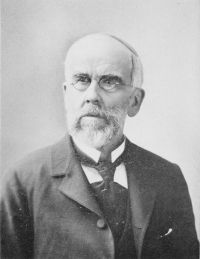
R. Torceanu

Biographical details

R. Torceanu,  A Simplified Grammar of the Roumanian Language (1883)

“ But there are greater difficulties than these with which we have to deal. There are in the Roumanian language nouns which though masculine in the singular become feminine in the plural. This plural ends in e or urĭ:
palat,⁠ ‘palace;’ palate, ‘palaces.’ pod, ‘bridge;’ podurĭ,⁠ ‘bridges.’ folos, ‘advantage;’⁠ folósse, ‘advantages.’ Many nouns belong to this class, and they can be learnt only by long practice.
To sum up what has already been said:—Masculine nouns generally end with a consonant; there are a few exceptions which end in e, ŭ, ĭ, and ă. All masculine nouns end in ĭ in the plural.
”
Source: Wikisource

R. Torceanu,  A Simplified Grammar of the Roumanian Language (1883)

“ In narrative we frequently substitute the present for the past, and the imperfect is very often used instead of the conditional.
The simple perfect and the simple pluperfect are used only in narrative.
In conversation we use the compound perfect when speaking of the past:
E.g.⁠ M’am preumblat, ‘I took a walk.’ Am spus adevĕrul,⁠ ‘I told the truth.’ etc. The past participle remains unchanged in all compound tenses of the active voice. In the passive voice only does it conform to the number and gender of its subject, being then of course only an adjective.
”
Source: Wikisource

R. Torceanu,  A Simplified Grammar of the Roumanian Language (1883)

“ Before considering these inflections let us look at the three verbs—a ave, ‘to have;’ a fi, ‘to be;’ and a voi, ‘to will;’ which serve as auxiliary verbs. ‘To will’ being a regular verb, we insert it here only in the present indicative.
A ave, ‘to have.’
Indicative Present (Presentul Indicativuluĭ) .
eŭ am, ‘I have.’⁠ ⁠noĭ avem, tu aĭ, ⁠voĭ aveṭĭ, el are, ⁠eĭ aŭ. When used as an auxiliary, an abbreviated form is given to the third person singular, and to the first and second persons plural. Thus—
eŭ am arat, ‘I have ploughed.’⁠ ⁠noĭ am arat (not avem arat) .
”
Source: Wikisource

Get perspective with Kwize: daily news enlightened by great literature