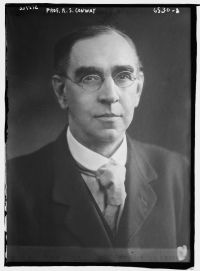
Thomas Ashby and Robert Seymour Conway

Biographical details

Thomas Ashby and Robert Seymour Conway 1911 Encyclopædia Britannica, Volume 16… (1911)

It may be observed that, long after the Latins had ceased to exist as a separate people we meet in Roman writers with the phrase of nomen Latinum, used not in an ethnical but a purely political sense, to designate the inhabitants of all those cities on which the Romans had conferred “Latin rights” (jus Latinum) —an inferior form of the Roman franchise, which had been granted in the first instance to certain cities of the Latins, when they became subjects of Rome, and was afterwards bestowed upon many other cities of Italy, especially the so-called Latin colonies.
Source: Wikisource

Thomas Ashby and Robert Seymour Conway 1911 Encyclopædia Britannica, Volume 16… (1911)

In the Renaissance, it is true, falls the erection of many fine villas in the neighbourhood of Rome—not only in the hills round the Campagna, but even in certain places in the lower ground, e.g. those of Julius II. at La Magliana and of Cardinal Trivulzio at Salone,—and these continued to be frequented until the end of the 18th century, when the French Revolution dealt a fatal blow to the prosperity of the Roman nobility.
Source: Wikisource

Thomas Ashby and Robert Seymour Conway 1911 Encyclopædia Britannica (1911)

It is now one of the most urgent problems in the history of Italy to determine the actual historical relation (see further Rome: History, ad. init.) between the Ὀμβροί of, say, Herodotus and the language of Iguvium, of which we may now offer some description, using the term Umbrian strictly in this sense.
Under the headings Latin Language and Osca Lingua there have been collected (1) the points which separate all the Italic languages from their nearest congeners, and (2) those which separate Osco-Umbrian from Latin.
Source: Wikisource

Get perspective with Kwize: daily news enlightened by great literature