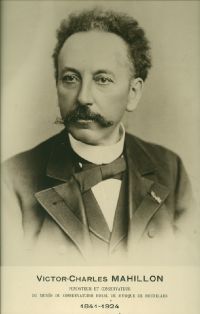
Victor Mahillon and Kathleen Schlesinger

Biographical details

Victor Mahillon and Kathleen Schlesinger 1911 Encyclopædia Britannica, Volume 7… (1911)

We must, however, regret from the point of view of art that its success has been so great, and that it has ended in usurping in brass bands the place of the bugles, the tone colour of which is infinitely preferable as a foundation for an ensemble composed entirely of brass instruments. Even the symphonic orchestra has not been secure from its intrusion, and the growing tendency in some orchestras, notably in France, to allow the cornet to supersede the trumpet, to the great detriment of tone colour, is to be deplored.
Source: Wikisource

Victor Mahillon and Kathleen Schlesinger 1911 Encyclopædia Britannica (1911)

The quality of tone varies greatly in the different instruments and registers. The alto trombone has neither power nor richness of tone, but sounds hard and has a timbre between that of a trumpet and a French horn. The tenor and bass have a full rich quality suitable for heroic, majestic music, but the tone depends greatly on the performer's method of playing; the modern tendency to produce a harsh, noisy blare is greatly to be deplored.
Besides the slide trombone, which is most largely used, there are the valve trombones, and the double-slide trombones.
Source: Wikisource

Victor Mahillon and Kathleen Schlesinger 1911 Encyclopædia Britannica, Volume 7… (1911)

A clue to the popularity of the instrument during the middle ages may perhaps be found in Artusi’s remark that this instrument is the most apt in imitating the human voice, but that it is very difficult and fatiguing to play; the musician, he adds elsewhere, should adopt an instrument to imitate the voice as much as possible, such as the cornetto and the trombone. He mentions two players in Venice, Il Cavaliero del Cornetto and M. Girolamo da Udine, who excelled in the art of playing the cornet.
Source: Wikisource

Get perspective with Kwize: daily news enlightened by great literature