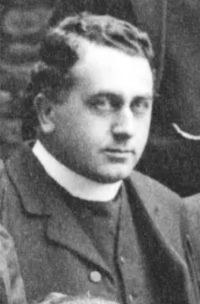
William Wallace and Griffithes Wheeler Thatcher

Biographical details

William Wallace and Griffithes Wheeler Thatcher 1911 Encyclopedia Britannica (1911)

But while the theologian incessantly postulated the agency of that God whose nature he deemed beyond the pale of science, the philosopher, following a purely human and natural aim, directed his efforts to the gradual elevation of his part of reason from its unformed state, and to its final union with the controlling intellect which moves and draws to itself the spirits of those who prepare themselves for its influences.
Source: Wikisource

William Wallace and Griffithes Wheeler Thatcher 1911 Encyclopædia Britannica (1910)

Avicenna was put in charge of a tutor, and his precocity soon made him the marvel of his neighbours,—as a boy of ten who knew by rote the Koran and much Arabic poetry besides. From a greengrocer he learnt arithmetic; and higher branches were begun under one of those wandering scholars who gained a livelihood by cures for the sick and lessons for the young. Under him Avicenna read the Isagoge of Porphyry and the first propositions of Euclid. But the pupil soon found his teacher to be but a charlatan, and betook himself, aided by commentaries, to master logic, geometry and the Almagest.
Source: Wikisource

William Wallace and Griffithes Wheeler Thatcher 1911 Encyclopedia Britannica (1911)

He is thought or intellect, the actuality, of which movement is but the fragmentary attainment in successive instants of time. Such a mind is not in the theological sense a creator, yet the onward movement is not the same as what some modern thinkers seem to mean by development. For the perfect and absolute, the consummation of movement is not generated at any point in the process; it is an ideal end, which guides the operations of nature, and does not wait upon them for its achievement. God is the unchanging essence of the movement, and therefore its eternal cause.
Source: Wikisource

Get perspective with Kwize: daily news enlightened by great literature