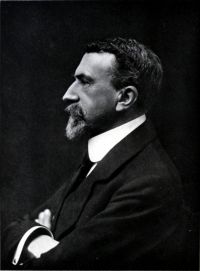
A. E. H. Tutton

A. E. H. Tutton

Crystals (1911)

Summary

Portrait of A. E. H. Tutton A. E. H. Tutton Crystals (1911)

HOW A CRYSTAL GROWS FROM A SOLUTION. One of the most deeply interesting aspects of a crystal, especially from the point of view of the history of crystallographic investigation, concerns the mysterious process of its growth from a solution (in a solvent) of the substance composing it. The story of the elucidation, as far as it has yet been accomplished, of the nature of crystallisation from solution in water is one of the most romantic which the whole of scientific progress can furnish. Again we are struck with the parallelism between crystals and living objects.
Source: Gutenberg

Portrait of A. E. H. Tutton A. E. H. Tutton Crystals (1911)

When nature has been permitted to have fair play, and the crystal has been deposited under ideal conditions, the planeness of its faces is astonishingly absolute. It is fully equal to that attained by the most skilled opticians after weeks of patient labour, in the production of surfaces on glass or other materials suitable for such delicate optical experiments as interference-band production, in which a distortion equal to one wave-length of light would be fatal.
Source: Gutenberg

Portrait of A. E. H. Tutton A. E. H. Tutton Crystals (1911)

We have had the “Molécules intégrantes” of Haüy, the “Polyhédres” of Bravais, the “Fundamentalbereich” of Schönflies, the “Parallelohedra” of von Fedorow, and the fourteen-walled cell, the “Tetrakaidecahedron” of Lord Kelvin, and again the “Polyhedra” of Pope and Barlow. Ideas have thus been extremely fertile, and indeed almost every variety of speculation has been indulged in as to the shape and nature of the unit of the structure which can exhibit such remarkable evidences of organisation and such extraordinary optical and other physical properties as those of a crystal.
Source: Gutenberg

Get perspective with Kwize: daily news enlightened by great literature