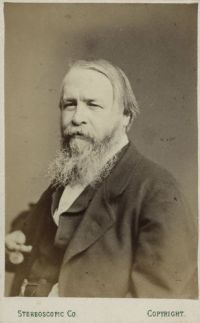
A. J. B. Beresford Hope

A. J. B. Beresford Hope

Summary

Portrait of A. J. B. Beresford Hope A. J. B. Beresford Hope Hints towards peace in ceremonial matters (1874)

I do not believe that the adoption or rejection of distinctive dresses for the celebrant and assistants at the Holy Communion in parish churches, or the adoption of lights (irrespective of their practical need) at the same holy ordinance, can, in the present state of feeling among Churchmen, be left to adjust itself irrespective of some superior and controlling jurisdiction.
Source: Wikisource

Portrait of A. J. B. Beresford Hope A. J. B. Beresford Hope Hints towards peace in ceremonial matters (1874)

If it could be settled that certain forms of worship should be permitted at certain hours, no one could complain of being taken by surprise.
As to the distinctive dress at the Holy Communion, the question has really been brought within a very narrow compass. A prescription of such dresses applying to all churches is unquestionably found in a rubric of the Prayer Book of 1549, and is, as many contend, re-enacted in the existing ornaments rubric.
Source: Wikisource

Portrait of A. J. B. Beresford Hope A. J. B. Beresford Hope Hints towards peace in ceremonial matters (1874)

The general conclusion at which a dispassionate man must arrive is that, irrespective of specific rites or "ornaments," the ceremonial law of the Church of England—as on the one hand a body whose continuous corporate existence ranges over nearly thirteen hundred years, and on the other a Reformed Church, the principles of whose Reformation have to be gathered out of statutes, rubrics, canons, articles, proclamations, advertisements, visitation articles, &c., dating from 1547 to 1662—is far from being a simple question.
Source: Wikisource

Get perspective with Kwize: daily news enlightened by great literature