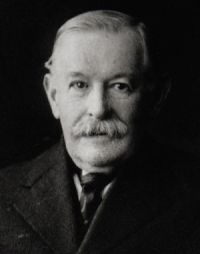
Robert Alexander Stewart Macalister

Robert Alexander Stewart Macalister

Summary

Portrait of Robert Alexander Stewart Macalister Robert Alexander Stewart Macalister 1911 Encyclopædia Britannica, Volume 1… (1911)

When sculptured decorations were added they frequently took the form of imitations of the actual festoons with which it was usual to ornament altars, or of symbols, such as crania and horns of oxen, referring to the victims sacrificed. As a rule, the altars which existed apart from temples bore the name of the person by whom they were dedicated and the names of the deities in whose service they were, or, if not the name, some obvious representation of the deity. Such, for example, is the purpose of the figures of the Muses on an altar dedicated to them, now to be seen in the British Museum.
Source: Wikisource

Portrait of Robert Alexander Stewart Macalister Robert Alexander Stewart Macalister 1911 Encyclopædia Britannica, Volume 1… (1911)

These primitive altars were of the simplest possible description—in fact they were required to be so by the regulation affecting them, preserved in Exodus xx. 24, which prescribes that in every place where Yahweh records his name an altar of earth or of unhewn stone, without steps or other extraneous ornamentation, shall be erected.
The priestly regulations affecting altars are of a very elaborate nature, and are framed with a single eye to the essential theory of later Hebrew worship—the centralization of all worship at one shrine.
Source: Wikisource

Portrait of Robert Alexander Stewart Macalister Robert Alexander Stewart Macalister 1911 Encyclopædia Britannica, Volume 1… (1911)

In this case the altar of Apollo at Delphi, upon which on the Greek vases Neoptolemus is frequently represented as taking refuge from Orestes, might be regarded as the pedestal of an invisible image of the god, and as fulfilling the same function as did the base of the actual image of Athene in Troy, towards which Cassandra fled from Ajax. The second class of altars, called βωμοί by the Greeks and altaria by the Romans, appears to have originated in temporary constructions such as heaps of earth, turf or stone, made for kindling a sacrificial fire as occasion required.
Source: Wikisource

Get perspective with Kwize: daily news enlightened by great literature