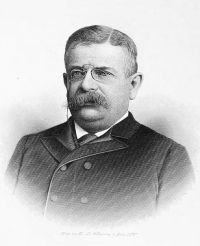
Abram J. Dittenhoefer

Abram J. Dittenhoefer

Summary

Portrait of Abram J. Dittenhoefer Abram J. Dittenhoefer,  How we elected Lincoln (1916)

“ Lincoln, in which his visit to Richmond came up, I casually inquired what he thought should be done with Jefferson Davis at the end of the war, which appeared then to be approaching. After a moment’s deliberation his sad face brightened as he answered that, if he had his way, he would let him die in peace on his Southern plantation. I remember well that at that time my interpretation of his words was that he would not permit any punishment to be inflicted on Jefferson Davis, unless it were absolutely demanded by the American people. ”
Source: Gutenberg

Portrait of Abram J. Dittenhoefer Abram J. Dittenhoefer,  How we elected Lincoln (1916)

“ As an answer to Douglas’s doctrine of popular sovereignty Lincoln said that he could not understand why, in the Territories, any man should be “obliged to have a slave if he did not want one. And if any man wants slaves,” argued Lincoln, “all other citizens in the Territory have no way of keeping that one man from holding them.”
He denounced fiercely the scheme of the Southern slaveholders to annex Cuba as a plan to increase the slave territory.
”
Source: Gutenberg

Portrait of Abram J. Dittenhoefer Abram J. Dittenhoefer,  How we elected Lincoln (1916)

“ I quote the following extracts from Lincoln’s message to Congress as showing his views on that question:
It is not needed, not fitting here, that a general argument should be made in favor of popular institutions, but there [Pg 50] is one point not so hackneyed to which I ask a brief attention—it is an effort to place capital on an equal footing with, if not above, labor in the structure of the Government. Capital is the fruit of labor, and could never have existed if labor had not existed. Labor is the superior of capital, and deserves much higher consideration.
”
Source: Gutenberg

Get perspective with Kwize: daily news enlightened by great literature