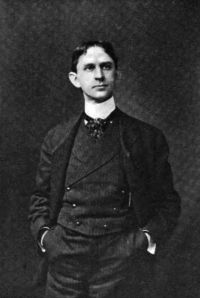
Albert Bigelow Paine

Albert Bigelow Paine

Summary

Portrait of Albert Bigelow Paine Albert Bigelow Paine "Peanut": The Story of a Boy

Then she packed a basket with eatables—good things such as Peanut had always liked. He would be tired of the things he could buy with his ten cents a day along the road. Tired? dear heart! As if a little boy trudging over range after range of lofty mountains, only to find range after range of still loftier ones beyond, could be tired of any kind of food! The Rose imagined how he would welcome the freshly cooked bread, and the coffee which she would make in the little pail. She felt much less unstrung now that she was really going to meet him, and more nearly happy than she had been for weeks.
Source: Gutenberg

Portrait of Albert Bigelow Paine Albert Bigelow Paine "Peanut": The Story of a Boy

The Rose of Texas found it hard climbing the mountain road. She began to realize now why it was that Peanut might be longer than he had counted on, and her heart ached for him more, and her arms ached, too, under the heavy load of blanket and basket. When she had been toiling up the hill for perhaps three hours she wondered how many miles she had come. But at a high turn of the road she paused to look back, and was surprised to see—almost behind her, it seemed—her own steep hillside, with the little clearing about Sam’s grave.
Source: Gutenberg

Portrait of Albert Bigelow Paine Albert Bigelow Paine "Peanut": The Story of a Boy

There came a sharp click, and the outlaw’s grave, the goldenrod, the fireweed, the black stumps, and the faded sleeping boy had been added to her store of choice in-gatherings.
There had been still another result. The snap of the shutter had brought the light figure to its feet, like some spry wood creature as suddenly disturbed. An instant more and he would have darted away into the bushes; only, Miss Schofield spoke just then, and with persuasiveness—the result of long pedagogical training.
“Don’t go! Oh, please don’t!” she pleaded, gently. “Please wait. I want so much to speak to you.”
Source: Gutenberg

Get perspective with Kwize: daily news enlightened by great literature