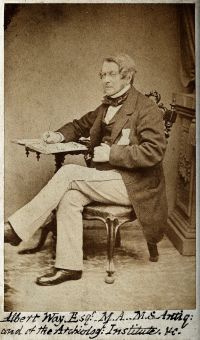
Albert Way

Albert Way

../../ (1846)

Summary

Portrait of Albert Way Albert Way,  ../../ (1846)

“ A large chalice with two handles, which could not easily be raised by a man, was preserved in the treasury of Mayence cathedral [3] .
The fashion of the chalice in primitive ages, was, probably, of the most simple kind. The silver chalice formerly exhibited to pilgrims at Jerusalem as the cup used by our Saviour at the last supper, was formed, as described by Bede, with two handles [4] ; and although the antiquity of the tradition may be questionable, it is not improbable that in many instances the shape of the calix ansatus may have been assimilated to such a revered model.
”
Source: Wikisource

Portrait of Albert Way Albert Way,  ../../ (1846)

“ The Greek Church had adopted the usage of dipping the bread in the wine, the administration being made with a spoon, (labida,) a practice supposed by some to have been not wholly unknown in the Western Church [10] , but the spoon, or cochlear, frequently named with the chalice in inventories, appears to have been used in pouring the wine and water thereinto, and in some instances to have served as a strainer [11] , properly called colatorium, for the formation of which detailed instructions are given by Theophilus. ”
Source: Wikisource

Portrait of Albert Way Albert Way,  ../../ (1846)

“ In forming a grave in Hereford cathedral, in 1836, a place of sepulture was brought to light, containing human remains, clothed in vestments which had been richly embroidered; at the right side lay a small chalice and paten of white metal, and on the paten were two pieces of wax taper, the wicks partly consumed, placed in the form of a cross. This singular circumstance seemed to indicate a practice, analogous, in some measure, to the deposit of the waxen sigillum, according to the ancient Custumal above mentioned, cited by Martene [28] . ”
Source: Wikisource

Get perspective with Kwize: daily news enlightened by great literature