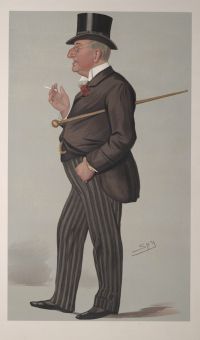
Alexander Meyrick Broadley

Alexander Meyrick Broadley

Summary

Portrait of Alexander Meyrick Broadley Alexander Meyrick Broadley Encyclopædia Britannica, Ninth Edition (1888)

The principal products of the country are corn, barley, olives, saffron, figs, and dates, these last being perhaps the finest in the whole of North Africa. Fruit also is abundant in cer tain parts, and so are many kinds of vegetables. The horses and mules, though small, are capable of much hard work. The native tissues and pottery are almost as good as those of Tunis. Great quantities of castor oil come from Tadjura. In consequence of recent events in Tunis, Tripoli has become the last surviving centre of the caravan trade to Northern Africa.
Source: Wikisource

Portrait of Alexander Meyrick Broadley Alexander Meyrick Broadley Encyclopædia Britannica, Ninth Edition (1888)

It is at least 250 miles nearer the great marts of the interior than either Tunis or Algiers. A large proportion of the commerce of Tripoli is in the hands of British merchants or dealers in British goods, who send cloth, cutlery, and cotton fabrics southwards and re ceive in return esparto grass, ivory, and ostrich feathers. The sirocco blows with great force at times during the autumn, and the heat is as a rule much greater than in Tunis. The climate is very variable; cold nights often succeed warm days; storms are of frequent occurrence
Source: Wikisource

Portrait of Alexander Meyrick Broadley Alexander Meyrick Broadley Encyclopædia Britannica, Ninth Edition (1888)

In the interior the population is very scattered, and it is not probable that the total exceeds from 800,000 to a million. The Europeans (2500 or 3000) on the coast are nearly all Maltese. There is a Jewish colony of about 4000 in the capital, and the trade is almost entirely in their hands and in those of the Maltese. [2]
Since 1835 Tripoli has lost the semi-independent character of a regency which it formerly enjoyed in common with Tunis, and has become a vilayet or outlying province of the Turkish empire.
Source: Wikisource

Get perspective with Kwize: daily news enlightened by great literature