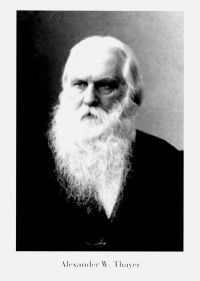
Alexander Wheelock Thayer

Alexander Wheelock Thayer

Summary

Portrait of Alexander Wheelock Thayer Alexander Wheelock Thayer A Dictionary of Music and Musicians (1900)

Köchel sensibly remarks that the trouble lay in Beethoven's 'aversion to the enforced performance of regular duties, especially to giving lessons, and teaching the theory of music, in which it is well known his strength did not lie, and for which he had to prepare himself.' When the untamed nature of Beethoven, and his deafness, are considered, together with his lack of worldly wisdom and his absolute need of a Mæcenas, one feels deeply how fortunate he was to have attracted and retained the sympathy and affection of a man of such sweet and tender qualities as Archduke Rudolph.
Source: Wikisource

Portrait of Alexander Wheelock Thayer Alexander Wheelock Thayer A Dictionary of Music and Musicians (1900)

For the second, in the highest degree distinguished alike for her intellectual and physical charms, Weber conceived a warm and deep, and, through the lady's virtues, a highly ennobling affection.' As Weber in 1812, so Beethoven the year before, who met her at Töplitz, whither she had come with the once-famous Countess von der Recke, whose house in Berlin, the 'Recksche Palais,' afterwards became the home of the Mendelssohns.
Source: Wikisource

Portrait of Alexander Wheelock Thayer Alexander Wheelock Thayer A Dictionary of Music and Musicians (1900)

Beethoven in 1817 told Fräulein Giannatasio, that he had struck his pupil's fingers, and, upon Rudolph's resenting the affront, had defended himself by pointing to a passage in one of the poets (Goethe?) which sustained him.
Beethoven's triple concerto, op. 56 (1804) , though dedicated to Prince Lobkowitz, was written, says Schindler, for the Archduke, Seidler, and Kraft. The work does not require great execution in the piano part, but a youth of sixteen able to play it must be a very respectable performer.
Source: Wikisource

Get perspective with Kwize: daily news enlightened by great literature