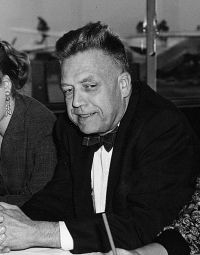
Alfred Charles Kinsey

Alfred Charles Kinsey

Summary

Portrait of Alfred Charles Kinsey Alfred Charles Kinsey New Pacific Coast Cynipidæ (Hymenoptera… (1922)

The adults are all imperfect. Holotype female and paratype adults and galls in the collections of The American Museum of Natural History; paratype adults in the collection of the author; galls at Leland Stanford University and the U. S. National Museum. These galls develop early on the unfolding leaves, looking like small air-bubbles blown in the tissue. The galls were always very new and fresh when gathered, but were also practically mature. The development of this generation of the species must be a matter of only a month or two; the other generation is unknown.
Source: Wikisource

Portrait of Alfred Charles Kinsey Alfred Charles Kinsey New Pacific Coast Cynipidæ (Hymenoptera… (1922)

In the male of atrimentus the abdomen is not as small as in palustris. Atrimentus occurs on a white oak in one distinct faunal area; palustris on black oaks in a very different faunal area. It is exceedingly significant that the galls of the two species show similarity of structure, for as has been repeatedly shown the gall is an expression of the physiological nature of the insect.
Source: Wikisource

Portrait of Alfred Charles Kinsey Alfred Charles Kinsey New Pacific Coast Cynipidæ (Hymenoptera… (1922)

Of 23 adults, 13 were females. This species resembles Andricus palustris form palustris (Osten Sacken) of the black oaks of the eastern part of the United States, and it might prove desirable to consider the two as varieties of one species. Morphologically the two are very similar, even in many minute details of venation, thoracic sculpture, abdominal and antennal characters; in atrimentus the parapsides are more convergent at the scutellum, the scutellum is less elongate, less rugose, with the foveal groove smoother and less distinctly bifoveate than in palustris.
Source: Wikisource

Get perspective with Kwize: daily news enlightened by great literature