Summary

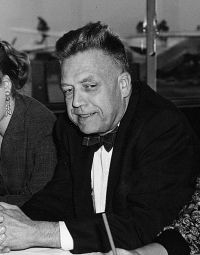
Portrait of Alfred Charles Kinsey Alfred Charles Kinsey Phylogeny of Cynipid Genera and Biological Characteristics (1920)

It would be surprising to find that species with the open radial cell had developed the veins necessary to close the cell and thus originated the closed-cell forms. Evidence of evolution based on a consideration of this point alone would be meager enough, but if it parallels the data of other sorts it will lend that much more weight to the final conclusions, and at a couple of points it will bridge gaps in the history.
Source: Wikisource

Portrait of Alfred Charles Kinsey Alfred Charles Kinsey Phylogeny of Cynipid Genera and Biological Characteristics (1920)

The necessity of the larva passing its life within a gall greatly reduces the parent's chance of finding the proper place in which to oviposit. The parent gall-wasps of most species must find a plant of the one genus and possibly of the one or two species of that genus on which alone it can survive. In most species, moreover, the parent must find a particular part of that special host and, failing to arrive at that spot within the very few hours of its adult life, the insect dies without effecting reproduction.
Source: Wikisource

Portrait of Alfred Charles Kinsey Alfred Charles Kinsey Phylogeny of Cynipid Genera and Biological Characteristics (1920)

This belief may be due to our inadequate knowledge of biological phenomena, but it is significant that the agamic species of cynipids (e. g., Rhodites, Disholcaspis, and the genera with an alternation of generations) more often fail to reach maturity than do species of the bisexual groups (Aulacidea, Diastrophus, etc.) . It is a common experience to obtain only a score of adults from hundreds of the oak- or rose-galls, while many hundreds of adults may be secured easily from a score of galls of Aulacidea, for instance.
Source: Wikisource

Get perspective with Kwize: daily news enlightened by great literature