Summary

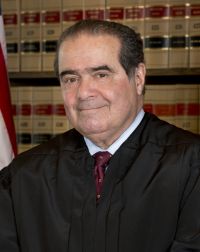
Portrait of Antonin Scalia Antonin Scalia City of Columbia v. Omni Outdoor Advertising Inc…

We reiterate that, with the possible market participant exception, any action that qualifies as state action is "ipso facto . . . exempt from the operation of the antitrust laws," id., at 568, 104 S.Ct., at 1995. This does not mean, of course, that the States may exempt private action from the scope of the Sherman Act; we in no way qualify the well-established principle that "a state does not give immunity to those who violate the Sherman Act by authorizing them to violate it, or by declaring that their action is lawful."
Source: Wikisource

Portrait of Antonin Scalia Antonin Scalia City of Columbia v. Omni Outdoor Advertising Inc…

To extend it to a context in which the regulatory process is being invoked genuinely, and not in a "sham" fashion, would produce precisely that conversion of antitrust law into regulation of the political process that we have sought to avoid. Any lobbyist or applicant, in addition to getting himself heard, seeks by procedural and other means to get his opponent ignored. Policing the legitimate boundaries of such defensive strategies, when they are conducted in the context of a genuine attempt to influence governmental action, is not the role of the Sherman Act.
Source: Wikisource

Portrait of Antonin Scalia Antonin Scalia City of Columbia v. Omni Outdoor Advertising Inc…

The impracticality of such a principle is evident if, for purposes of the exception, "conspiracy" means nothing more than an agreement to impose the regulation in question. Since it is both inevitable and desirable that public officials often agree to do what one or another group of private citizens urges upon them, such an exception would virtually swallow up the Parker rule: All anticompetitive regulation would be vulnerable to a "conspiracy" charge.
Source: Wikisource

Get perspective with Kwize: daily news enlightened by great literature