Summary

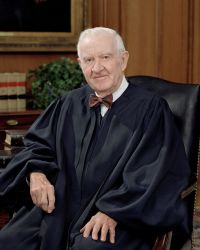
Portrait of John Paul Stevens John Paul Stevens City of Columbia v. Omni Outdoor Advertising Inc…

The Court's assumption that an agreement between private parties and public officials is an "inevitable" precondition for official action, however, is simply wrong. [8] Indeed, I am persuaded that such agreements are the exception rather than the rule, and that they are, and should be, disfavored. The mere fact that an official body adopts a position that is advocated by a private lobbyist is plainly not sufficient to establish an agreement to do so.
Source: Wikisource

Portrait of John Paul Stevens John Paul Stevens City of Columbia v. Omni Outdoor Advertising Inc…

It is nevertheless important to determine when purported general welfare regulation in fact constitutes economic regulation by its purpose and effect of displacing competition. "An example of economic regulation which is disguised by another stated purpose is the limitation of advertising by lawyers for the stated purpose of protecting the public from incompetent lawyers. Also, economic regulation posing as safety regulation is often encountered in the health care industry."
Source: Wikisource

Portrait of John Paul Stevens John Paul Stevens City of Columbia v. Omni Outdoor Advertising Inc…

The South Carolina statutes that confer zoning authority on municipalities in the State do not articulate any state policy to displace competition with economic regulation in any line of commerce or in any specific industry. As the Court notes, the state statutes were expressly adopted to promote the " 'health, safety, morals or the general welfare of the community,' " see ante, at 370, n. 3. Like Colorado's grant of "home rule" powers to the city of Boulder, they are simply neutral on the question whether the municipality should displace competition with economic regulation in any industry.
Source: Wikisource

Get perspective with Kwize: daily news enlightened by great literature