Summary

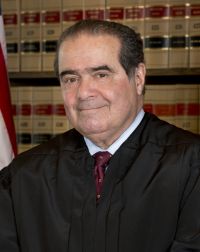
Portrait of Antonin Scalia Antonin Scalia Hunter v. Bryant — Opinion of the Court

The question in this case is not whether a reasonable officer could have believed that respondent posed a threat to the life of the President. Those "who guard the life of the President," ante, at 229 (SCALIA, J., concurring in judgment) , properly rely on the slightest bits of evidence-nothing more than hunches or suspicion-in taking precautions to avoid the ever-present danger of assassination. Mere suspicion is obviously a sufficient justification for a host of protective measures such as, for example, careful surveillance of a person like respondent.
Source: Wikisource

Portrait of Antonin Scalia Antonin Scalia Hunter v. Bryant — Opinion of the Court

The District Court denied the petitioners' motion for summary judgment seeking dismissal on the ground of qualified immunity because it decided that further fact-finding was necessary. On such a motion, the court was of course required to resolve any disputed question of fact against the moving parties. In my opinion the Court of Appeals correctly stated the governing standards when it wrote:
"Qualified immunity is an affirmative defense for which the government official bears the burden of proof.
Source: Wikisource

Portrait of Antonin Scalia Antonin Scalia Hunter v. Bryant — Opinion of the Court

Bryant's letter advances a conspiracy theory accusing the National Council of Churches of spreading communism and scheming to assassinate the President. [2] Such a theory is of course absurd, but this absurdity does not mean that Bryant was threatening to harm the President. A vast gap separates the conclusion that a letter warning of an assassination threat is preposterous or delusional and the conclusion that the letter, itself, constitutes a threat by the author.
Source: Wikisource

Get perspective with Kwize: daily news enlightened by great literature