Summary

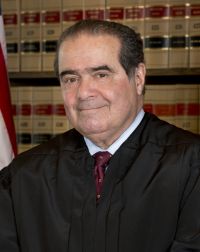
Portrait of Antonin Scalia Antonin Scalia Michael H. v. Gerald D. — Opinion of the Court (1989)

We have never had occasion to decide whether a child has a liberty interest, symmetrical with that of her parent, in maintaining her filial relationship. We need not do so here because, even assuming that such a right exists, Victoria's claim must fail. Victoria's due process challenge is, if anything, weaker than Michael's. Her basic claim is not that California has erred in preventing her from establishing that Michael, not Gerald, should stand as her legal father. Rather, she claims a due process right to maintain filial relationships with both Michael and Gerald.
Source: Wikisource

Portrait of Antonin Scalia Antonin Scalia Michael H. v. Gerald D. — Opinion of the Court (1989)

Such a happy choice is rarely available. Here, to provide protection to an adulterous natural father is to deny protection to a marital father, and vice versa. If Michael has a "freedom not to conform" (whatever that means) , Gerald must equivalently have a "freedom to conform." One of them will pay a price for asserting that "freedom"-Michael by being unable to act as father of the child he has adulterously begotten, or Gerald by being unable to preserv the integrity of the traditional family unit he and Victoria have established.
Source: Wikisource

Portrait of Antonin Scalia Antonin Scalia Michael H. v. Gerald D. — Opinion of the Court (1989)

What he must establish, therefore, is not that our society has traditionally allowed a natural father in his circumstances to establish paternity, but that it has traditionally accorded such a father parental rights, or at least has not traditionally denied them. Even if the law in all States had always been that the entire world could challenge the marital presumption and obtain a declaration as to who was the natural father, that would not advance Michael's claim.
Source: Wikisource

Get perspective with Kwize: daily news enlightened by great literature