Summary

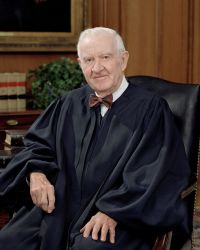
Portrait of John Paul Stevens John Paul Stevens Michael H. v. Gerald D. — Opinion of the Court (1989)

The plurality has wedged itself between a rock and a hard place. If it limits its holding to those situations in which a wife and husband wish to raise the child together, then it necessarily takes the State's interest into account in defining "liberty"; yet if it extends that approach to circumstances in which the marital union already has been dissolved, then it may no longer rely on the State's asserted interest in protecting the "unitary family" in denying that Michael and Victoria have been deprived of liberty.
Source: Wikisource

Portrait of John Paul Stevens John Paul Stevens Michael H. v. Gerald D. — Opinion of the Court (1989)

In the plurality's constitutional universe, we may not take notice of the fact that the original reasons for the conclusive presumption of paternity are out of place in a world in which blood tests can prove virtually beyond a shadow of a doubt who sired a particular child and in which the fact of illegitimacy no longer plays the burdensome and stigmatizing role it once did.
Source: Wikisource

Portrait of John Paul Stevens John Paul Stevens Michael H. v. Gerald D. — Opinion of the Court (1989)

Even if we can agree, therefore, that "family" and "parenthood" are part of the good life, it is absurd to assume that we can agree on the content of those terms and destructive to pretend that we do. In a community such as ours, "liberty" must include the freedom not to conform. The plurality today squashes this freedom by requiring specific approval from history before protecting anything in the name of liberty.
The document that the plurality construes today is unfamiliar to me. It is not the living charter that I have taken to be our Constitution
Source: Wikisource

Get perspective with Kwize: daily news enlightened by great literature