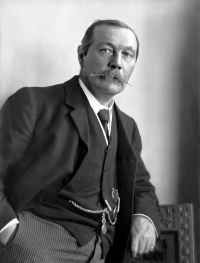
Arthur Conan Doyle

Arthur Conan Doyle

Summary

Portrait of Arthur Conan Doyle Arthur Conan Doyle Through the Magic Door — Chapter 8 (1907)

But of all types of soldier the best is the man who is keen upon his work, and yet has general culture which enables him to see that work in its due perspective, and to sympathize with the gentler aspirations of mankind. Such a man is Mercer, an ice-cool fighter, with a sense of discipline and decorum which prevented him from moving when a bombshell was fizzing between his feet, and yet a man of thoughtful and philosophic temperament, with a weakness for solitary musings, for children, and for flowers.
Source: Wikisource

Portrait of Arthur Conan Doyle Arthur Conan Doyle Through the Magic Door — Chapter 8 (1907)

I cannot, like Livy, compose a fine harangue for my hero, and, of course, I could not retain the precise words, but the import of them was to exhort them to bear their sufferings with fortitude; not to repine, like women or children, at what every soldier should have made up his mind to suffer as the fortune of war, but above all, to remember that they were surrounded by Englishmen, before whom they ought to be doubly careful not to disgrace themselves by displaying such an unsoldier-like want of fortitude.
Source: Wikisource

Portrait of Arthur Conan Doyle Arthur Conan Doyle Through the Magic Door — Chapter 8 (1907)

Warfare was no child's play about the time when Tilly sacked Magdeburg, and Cromwell turned his hand from the mash tub to the sword. It might not be much better now in a long campaign, when men were hardened and embittered. Many of these laws are unrepealed, and it is less than a century since highly disciplined British troops claimed their dreadful rights at Badajos and Rodrigo. Recent European wars have been so short that discipline and humanity have not had time to go to pieces, but a long war would show that man is ever the same, and that civilization is the thinnest of veneers.
Source: Wikisource

Get perspective with Kwize: daily news enlightened by great literature