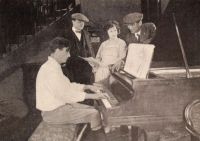
Arthur Somers Roche

Arthur Somers Roche

Summary

Portrait of Arthur Somers Roche Arthur Somers Roche Figures Can't Lie (1915)

He must be the man who had notified the Secretary of the treason, Tenney started to fold up the list, his eye running idly down the columns of names as he did so. As though printed in letters of flame, he saw the name, Henry Davis. The camera eye begets the photographic brain. He knew the name, and the face that the name belonged to stood before his mental eyes. Yet Tenney did not start, gave no sign of emotion. He merely folded the paper neatly and handed it to the chief clerk who had procured it for him with a languid thanks.
Source: Wikisource

Portrait of Arthur Somers Roche Arthur Somers Roche Figures Can't Lie (1915)

Matter-of-fact, almost phlegmatic, was Tenney; that disembodied spirits had copied the plans, Tenney did not believe. And yet—figures could not lie, as the Secretary had hopelessly declared.
Didn't the Japanese boast of a culture, an education, a religion, that went back to those ages before Christianity dawned? Didn't intelligent men claim that the ancient civilizations of Asia were close to the scheme of the Universe and the Powers that planned the scheme? For one fraction of a second Tenney felt his flesh crawl.
Source: Wikisource

Portrait of Arthur Somers Roche Arthur Somers Roche Figures Can't Lie (1915)

But, old man, when you told us you knew the traitor, weren't you—er—patting yourself a bit on the back? Weren't you—er—bragging when you said, before you began work on the case, that you knew the identity of the traitor?"
Tenney grinned.
"You ain't got the memory I have, Chief, or else you'd know that I didn't say that I knew who the traitor was; I said I knew where he was! I knew he was in the War Department all the time. Come again, Chief, you ain't caught me yet!"
"I wonder if any one ever will," said Dilkes thoughtfully.
Source: Wikisource

Get perspective with Kwize: daily news enlightened by great literature