Summary

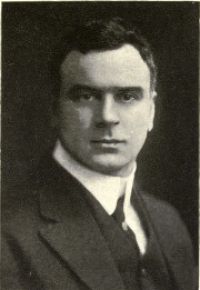
Portrait of Arthur Stringer Arthur Stringer The Man Who Couldn't Sleep — IV. The Open Door (1919)

I noticed, as I turned, into Fifth Avenue, that the moving finger of light on the Metropolitan clock-dial pointed to an hour past midnight. So I veered about that delta of idleness, where the noontide turbulence of Broadway empties its driftwood into the quietness of the square, and pursued my way up the avenue.
No one can claim to know New York who does not know its avenues in those mystical small hours that fall between the revolving street-sweeper and the robin-call of the first morning paper.
Source: Wikisource

Portrait of Arthur Stringer Arthur Stringer The Man Who Couldn't Sleep — IV. The Open Door (1919)

I was just in time to see the figure that darted out through the suddenly opened door of the clothes-closet.
I found myself confronted by a man, a thin-lipped, heavy-jawed man of about thirty-five, with black pinpoint pupils to his eyes. He wore a small-rimmed derby hat and a double-breasted coat of blue cheviot. But it was not his clothes that especially interested me. What caught and held my attention was the ugly, short-barreled revolver which was gripped in the fingers of his right hand. This revolver, I noticed, was unmistakably directed at me as he advanced into the room.
Source: Wikisource

Portrait of Arthur Stringer Arthur Stringer The Man Who Couldn't Sleep — IV. The Open Door (1919)

Yet along this lateral valley of quietness I wandered as disconsolately as before. What impressed me now was the monotony of the house-fronts which shouldered together, block by block. Each front seemed of the same Indiana limestone, of the same dull gray, as though, indeed, the whole district were a quarry checker-boarded by eroding cross-currents out of the self-same rock. Each tier of windows seemed backed by the same blinds, each street-step barricaded by the same door.
Source: Wikisource

Get perspective with Kwize: daily news enlightened by great literature