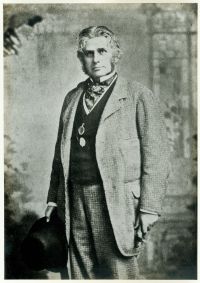
Augustus Henry Lane-Fox Pitt-Rivers

Augustus Henry Lane-Fox Pitt-Rivers

Summary

Portrait of Augustus Henry Lane-Fox Pitt-Rivers Augustus Henry Lane-Fox Pitt-Rivers Antique Works of Art from Benin

Charles Read, F.S.A., has found its way into the British Museum; others no doubt have fallen into the hands of persons whose chief interest in them has been as relics of a sensational and bloody episode, but their real value consists in their representing a phase of art—and rather an advanced stage—of which there is no actual record, although no doubt we cannot be far wrong in attributing it to European influence, probably that of the Portuguese some time in the sixteenth century.
Source: Gutenberg

Portrait of Augustus Henry Lane-Fox Pitt-Rivers Augustus Henry Lane-Fox Pitt-Rivers Antique Works of Art from Benin

On the top is a pointed spike of wood, 5 inches in height, on which the head of the victim appears to have rested, and below this on the surface at the top of the block are two receptacles for the thumbs of the victim, in the form of coiled mud-fish. The ornamentation on the top consists of squares and triangles filled with parallel straight lines alternating in direction, and edged with a circle of broken guilloche pattern. On the sides are three human figures, two of which are holding hands upwards, weapons and shields, and one a curved sword of European form, point downwards.
Source: Gutenberg

Portrait of Augustus Henry Lane-Fox Pitt-Rivers Augustus Henry Lane-Fox Pitt-Rivers Antique Works of Art from Benin

A human figure is in the mouth of the serpent resting on the base, holding a bill-hook in his left hand, similar to Figs. 108 and 109, Plate XVIII. On the underside of the seat, the serpent holds a leopard in its mouth; leopard holding a palm branch in its mouth. The other figures carved on the base and underside of the top are two degenerate mud-fish and two degenerate elephants’ heads, the proboscis terminating in a human hand, like Figs. 72 and 167. The seat is ornamented with an interlaced guilloche pattern surrounding the top edge of the seat.
Source: Gutenberg

Get perspective with Kwize: daily news enlightened by great literature