“ If you could fancy some mighty serpent transformed into man, preserving in the human lineaments the old serpent type, you would have a better idea of that countenance than long descriptions can convey: the width and flatness of frontal—the tapering elegance of contour disguising the strength of the deadly jaw—the long, large, terrible eye, glittering and green as the emerald—and withal a certain ruthless calm, as if from the consciousness of an immense power. ”
Serpent
Definition and stakes
The serpent, a symbol of duality and transformation, has permeated literary and mythological traditions as a figure of both peril and transcendence. From Sabine Baring-Gould’s mythic portrayal of the serpent as a regal, pre-human creature adorned with gem-like eyes to Lorenzo Scupoli’s caution about its concealed malice in The Spiritual Combat, the motif reflects the tension between attraction and risk.
Scientific writings, such as Frank E. Beddard’s admiration for the serpent’s “perfection of structure,” contrast with fables like La Fontaine’s story of venomous rivalry, while symbolic interpretations—such as the ouroboros—connect it to cycles of life and eternity. These diverse viewpoints reveal the serpent as a liminal creature, bridging the natural and the symbolic.
Quotes about “serpent”
Sabine Baring-Gould,
Legends of Old Testament Characters
(1871)
“ The serpent was formerly queen of all creatures. She had a head like rubies, and eyes like emeralds. Her height was that of a camel, and the most beautiful colours adorned her skin, and her hair and face were those of a beautiful maiden. She was fragrant as musk and amber; her food was saffron; sweet hymns of praise were uttered by her melodious tongues; she slept by the waters of the heavenly river Kaulhar; she had been created a thousand years before man, and was Eve's favourite companion. ”
Frank E. Beddard, The Cambridge natural history, Vol…
“ It might be said with perfect truth that a serpent is in its way an example of perfection of structure: not incommoded with limbs it can slip rapidly through the grass, swim like a fish, climb like a monkey, and dart upon its prey with rapidity and accuracy. ”

J. G. Wood, Nature's Teachings: Human Invention Anticipated by Nature
“ The serpent has neither hands nor talons, yet it can outwrestle the athlete, and crush the tiger in the embrace of its ponderous overlapping folds. Instead of licking up its food as it glides along, the serpent uplifts its crushed prey, and presents it, grasped in the death-coil as in hand, to its slimy, gaping mouth. ”
Lorenzo Scupoli,
The Spiritual Combat
(1875)
“ If the beauty of a creature fascinates you, remember that the serpent of Hell lies hidden beneath it, anxious and ready to kill or at least wound you, and say to him—"Ah, accursed serpent, with what subtlety dost thou lay wait to devour me!" ”
Angelo De Gubernatis,
Zoological Mythology; or, The Legends of Animals…
“ The symbolical representation of the solar year in the form of a serpent biting his tail is equivalent to the myth of the monster-serpent who dies when his eggs are broken, that is, when the light comes out of its tenebrous envelope. ”
Jean de La Fontaine, Fables of La Fontaine — a New Edition…
“ Thy temper and thy teeth malign Shall never hurt a hair of mine.' The muffled serpent, on his side, The best a serpent could, replied,-- 'If all this world's ingrates Must meet with such a death, Who from this worst of fates Could save his breath? ”
Oliver Cowdery,
Latter Day Saints' Messenger and Advocate…
“ The serpent, represented as walking, or formed in a manner to be able to walk, standing in front of, and near a female figure, is to me, one of the greatest representations I have ever seen upon paper, or a writing substance; and must go so far towards convincing the rational mind of the correctness and divine authority of the holy scriptures, and especially that part which has ever been assailed by the infidel community, as being a fiction, as to carry away, with one might sweep, the whole atheistical fabric, without leaving a vestige sufficient for a foundation stone. ”
The Eliminator; or, Skeleton Keys to Sacerdotal Secrets
“ Indeed, the serpent has almost universally been regarded as a symbol of immortal life, and especially, as frequently presented in ancient sculptures, with its tail in its mouth, thus forming an endless circle. ”
William Henry Hudson,
Green Mansions
(1904)
“ Seeing her thus, all those emotions of fear and abhorrence invariably excited in us by the sight of an active venomous serpent in our path vanished instantly from my mind: I could now only feel astonishment and admiration at the brilliant being as she advanced with swift, easy, undulating motion towards me; or rather towards the serpent, which was now between us, moving more and more slowly as she came nearer. ”
Catherine Cooper Hopley,
Snakes: Curiosities and Wonders of Serpent Life
“ Add to the two great death-dealing powers of the serpent race—constriction and venom—those other peculiarities which have here been faithfully recorded, the seeming renewal of life after the annual sleep, a mystery enhanced by the restored brilliancy and beauty of the reptile on its change of cuticle; let us picture to ourselves those wondering savages now watching the limbless creature as it glides into sight and is gone again, or as with fixed and glittering eyes it flickers that mysterious little tongue ”
“ A little way off, on the broken edges of the basin opposite, a serpent, glittering in all its native splendor of burnished green, and red and gold, raises its crest, and looks on him with its glittering eyes. Man and reptile alike had tasted the waters. The one steals slowly away, rustling on its winding trail—a thing of fear, but innocent in its desires ”
Anna Harriette Leonowens,
Life and Travel in India
“ In the oldest hieroglyphics the serpent with its tail in its mouth stood for cycles of time, for the horizon, for eternity, and for life to come. Twined around the crown of ancient Oriental kings and queens, it symbolized the fatal sting lurking beneath the power entrusted to them ”
Charles Owen, An essay towards a natural history of serpents (1742)
“ The Serpent having ascrib’d its Reason, and Speech to the eating of that Fruit, the Woman might infer, If this Fruit did turn a Serpent into a rational Creature, why may it not transform a rational Creature into a God, and a Woman into a Goddess? ”
W. Bion Adkins, The Jericho Road
“ Its bright eyes sparkle. Its whole body seems animated. A man emerges from the heavy foliage. Their eyes meet. The serpent quails before the man—man is victor. The serpent is under control of a master. ”
Jack London,
The Star Rover
(1915)
“ The marks of the sea are still on us, as the marks of the serpent are still on us, ere the serpent became serpent and we became we, when pre-serpent and pre-we were one. Once we flew in the air, and once we dwelt aboreally and were afraid of the dark. ”
Sabine Baring-Gould,
Curiosities of Olden Times
(1896)
“ Here we have the serpent omitted, which is the principal animal to be considered, for really the serpent is the owner of the stone that grows in its head. This idea is very general—that the carbuncle is to be found in a serpent's head. Pliny has this notion; indeed it is found everywhere. [15] The origin of this myth is that the great serpent is the heaven-god—and on the gnostic seals we have the Demiurge so represented as a crowned or nimbed serpent. In the head of this great heaven-god is the sun, the glorious stone that gives life and light and gladness and plenty. ”
John Doughty, The Garden of Eden (1885)
“ The most ancient people denominated the sensual nature the serpent, because as serpents live close to the earth, so does the sensual principle cling closely to the world, to nature, and things of sense. ”
“ May a young and amiable generation spring into life, and mature under their eyes! Birds of prey shall not easily penetrate here. Only grant that the serpent, the frightful black serpent, may never visit this nest! ”
John Milton,
Paradise Lost
(1667)
“ nor unknown The serpent, subtlest beast of all the field, Of huge extent sometimes, with brazen eyes And hairy mane terrifick, though to thee Not noxious, but obedient at thy call. ”
Angelo De Gubernatis,
Zoological Mythology; or, The Legends of Animals…
“ When the day or the summer dies, the mythical serpent shows himself (in absolute contradiction to what we are taught by Natural History, one would almost say that when the serpent ceases to creep along the ground and to devour the animals of the earth, it goes to creep and to devour the animals of the sky) ; then the north winds begin to whistle,—and the serpent, particularly the mythical serpent, is a famous whistler. ”
Anna Harriette Leonowens,
Life and Travel in India
“ Thus, in the course of time, the serpent became an endless writing on the wall, so full was it of mysterious significance and dread to the ancient races of the world. In fact, serpents play an important part in the mythology of every nation of the earth. ”
“ When he came to the place where the serpent had been, he cried out: ‘O serpent, come here one moment, I want to ask thee something.’ The serpent came. The man told his grief. The serpent said: ‘If thou givest me half of what the king gives thee, I shall tell thee.’ He promised and swore. The serpent said: ‘This is a sign that now everywhere peace falls on all, the people are become like quiet, gentle sheep.’The peasant thanked it, and went his way. When he came to the king, he spoke as the serpent had instructed him. The king was exceedingly pleased, and gave him greater presents. ”
Various, The Contemporary Review, Volume 36…
“ But by the side of divine serpents, essentially benign in character, protective, prophetic, linked with gods of health, life, and healing, we do find in all mythologies a gigantic serpent, who personifies a hostile and nocturnal power, a wicked principle, material darkness, and moral evil. ”
Angelo De Gubernatis,
Zoological Mythology; or, The Legends of Animals…
“ To kill one of these serpents is to kill the head of the family. Under this aspect, as a protector of children, as a giver of husbands to girls, and identified with the head or progenitor of the family, the serpent is again a phallical form. From the gloomy serpent of night, the tenebrous serpent of winter, even the nocturnal and wintry heavens illumined by the moon, and from the white moon, emerges the diurnal sun, the sun of spring, the day and the warm and luminous season. ”
J. A. MacCulloch, The Religion of the Ancient Celts
“ The divinity of the serpent is proved by the occurrence of a horned serpent with twelve Roman gods on a Gallo-Roman altar.711 In other cases a horned or ram's-headed serpent appears as the attribute of a god, and we have seen that the ram's-headed serpent may be a fusion of the serpent as a chthonian animal with the ram, sacrificed to the dead. ”
Catherine Cooper Hopley,
Snakes: Curiosities and Wonders of Serpent Life
“ Many excellent and orthodox persons associate with a serpent all the sin and misery which ever existed on our globe, and are persuaded that the sooner everything in the shape of one is exterminated the better.On the other hand, those who can look at a snake with unprejudiced eyes and study its habits, find continual reason to wonder at and admire the extraordinary features which exhibit themselves in its organization. ”
Charles Owen, An essay towards a natural history of serpents (1742)
“ They represented the World by a Circle, in the middle of which was a Serpent, representing the good Demon, or Genius of the World, by which ’tis animated, and is a Symbol of the Almighty Creator. Behold here the Blasphemy of Satan, in giving to God the Form of a Serpent, which he had borrow’d himself to make war against God in Paradise. They sometimes represented their Gods with the Bodies of Serpents, and honour’d those odious Animals with divine Worship, as Symbols of Apollo, of the Sun, and of Medicine, and were put into the Charge of Ceres and Proserpine. ”
Rachel Harriette Busk, Roman Legends: A collection of the fables and folk-lore of Rome
“ Did you see a white serpent this morning?’‘Yes,’ she answered; ‘that I did, though my husband said there was no such thing as a white serpent in existence.’‘Well, if you would do me a pleasure, go back to the place where you saw the white serpent go in—not where he came out, but where you saw him go into the earth. Dig about that place, and, when you have dug a pretty good hole, a dead man will start up;3 but don’t be afraid, he can’t hurt you, and won’t want to hurt you. ”
George Jones, Excursions to Cairo, Jerusalem…
“ We see her always represented with a great serpent. Other paintings exhibit to us a feather-headed snake, cut in pieces by the great spirit Tercatlipoca, or by the sun personified, the god Tonatiuh.... ”
Matthew Henry, Commentary on the Whole Bible… (1700s)
“ A serpent upon a rock. The way of a serpent in the sand we may find by the track, but not of a serpent upon the hard rock; nor can we describe how a serpent will, without feet, in a little time creep to the top of a rock. ”
Mary Baker G. Eddy,
Science and Health with Key to the Scriptures
(1898)
“ Whence comes a talking, lying serpent, to tempt the children of divine Love? He enters into the metaphor Serpent. only as evil. We have nothing in the animal kingdom which represents the species herein described, — a talking serpent, — and should rejoice that evil, by whatever figure presented, contradicts itself, and has neither origin nor support in God, Good; so that we may have faith to fight all its claims as worthless. ”
Henry Osborn Taylor,
The Mediaeval Mind (Volume 1 of 2…
“ Again, the statement that the serpent rids itself of its skin by squeezing through a narrow hole, accords with the Scriptural injunction to imitate the serpent’s wisdom, and put off the old man that we may put on the new, and in a narrow place—Enter ye in at the strait gate, says the Lord. ”
Sanger Brown, The Sex Worship and Symbolism of Primitive Races…
“ Many reasons have been offered to explain why the serpent has been used to represent the male generative attribute. Some have called attention to its tenacity of life; others have spoken of its supposed mystic power of regeneration by casting its skin. ”
Lionel Lisle, The Two Tests: The Supernatural Claims of Christianity Tried by Two of Its Own Rules
“ The serpent, that he should go upon his belly, that he should eat dust, that he should hate mankind, that mankind should hate him, that men should bruise his head, that he should bruise men's heel. Is there anything here beyond natural fact more than in the case of the man or woman? Men trample on serpents, serpents bite men from heel to knee; they cannot as a rule strike higher. ”
W. H. Hudson,
Far Away and Long Ago: A History of My Early Life
“ CHAPTER XV SERPENT AND CHILD My pleasure in bird life—Mammals at our new home—Snakes and how children are taught to regard them—A colony of snakes in the house— Their hissing confabulations—Finding serpent sloughs—A serpent's saviour—A brief history of our English neighbours, the Blakes.It is not an uncommon thing, I fancy, for a child or boy to be more deeply impressed and stirred at the sight of a snake than of any other creature. ”
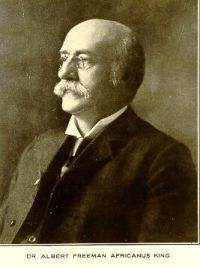
Albert Freeman Africanus King,
Popular Science Monthly
(1883)
“ But the serpent also is beautiful—superficially smooth, tapering in form, elegantly elastic, absolute in symmetry, undulating in motion, every element of beauty in woman finds its counterpart in the snake; yet we love the one, loathe the other—loathe it because we have inherited the instinct that tells us it is one of our natural enemies, whose touch is destruction ”
John Ashton, Curious Creatures in Zoology
“ Pliny saith, that if you take out the right eye of a serpent, and so bind it about any part of you, that it is of great force against the watering or dropping of the eyes, by meanes of a rhume issuing out thereat, if the serpent be againe let goe alive. And so hee saith, that a serpent’s or snake’s hart, if either it be bitten or tyed to any part of you, that it is a present remedie for the toothach: and hee addeth further, that if any man doe tast of the snake’s hart, that he shall never after be hurt of any serpent.... ”
Angelo De Gubernatis,
Zoological Mythology; or, The Legends of Animals…
“ Inasmuch, moreover, as from the monster serpent, the cloud and the darkness, come forth flashes of lightning, thunder-bolts, sunbeams, tongues of fire, even serpents sometimes assume a divine nature in the Vedic hymns. ”
Robert Butler, Narrative of the Life and Travels of Serjeant B—…
“ It has been said, indeed, that there is a serpent, or adder, to which the Psalmist's comparison literally applies; that it actually covers one ear with its tail, and applies the other close upon the ground, to prevent itself being overcome with the charms of music, so as to run the hazard of being taken and killed. We know certainly, both from Scripture and observation, that the serpent is subtile above all beasts of the field, but this surely is a piece of cunning which is beyond its nature. ”
Franz Delitzsch,
Biblical Commentary Old Testament…
(1885)
“ For God did not cause a real serpent to be taken, but the image of a serpent, in which the fiery serpent was stiffened, as it were, into dead brass, as a sign that the deadly poison of the fiery serpents was overcome in this brazen serpent. ”
Charles Owen, An essay towards a natural history of serpents (1742)
“ The next thing that comes under Consideration is, the Worship of Serpents, which is observed thro’ all the Pagan Antiquity. The Devil, who, under the Shape of a Serpent, tempted our first Parents, has, with unwearied Application, labour’d to deify that Animal, as a Trophy of his first Victory over Mankind. The Conquest made by the old Serpent in Paradise, and the wonderful Cures made by the Shadow of a Serpent in the Wilderness, contributed very much towards making that hateful Creature so venerable in the Eyes of so many Nations. ”
Edmund Burke,
The Works of the Right Honourable Edmund Burke…
“ The serpent, by his dangerous qualities, is not ill adapted to inspire terror,—by his annual renewals, to raise admiration,—by his make, easily susceptible of many figures, to serve for a variety of symbols,—and by all, to be an object of religious observance: accordingly, no object of idolatry has been more universal. ”