“ Then for a moment, far off in heavens, there would be a rift, or a thinning of the clouds, and the sunbeams, striking like lightning through their ranks, would illumine the pale blue mist, the slanting rain, the gaunt black boles and branches, glittering with wet, casting a momentary glory over the ocean-like tumult of nature. In the condition I was in, with a relaxed body and dejected mind, this tempestuous period, which would have only afforded fresh delight to a person in perfect health, had no charm for my spirit; but, on the contrary, it only served to intensify my gloom. ”
W. H. Hudson
Biographical details

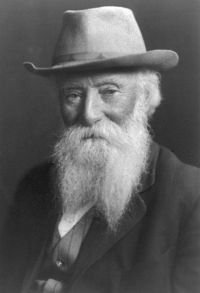
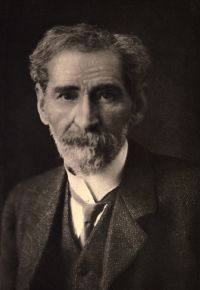
William Henry Hudson (1841–1922), a British-Argentinian naturalist and author, is celebrated for his vivid depictions of the natural world and his promotion of conservation. Born in the Argentine pampas, he observed and recorded local plant and animal life, later becoming a key figure in ornithology.
His works, such as Green Mansions (1904) and Idle Days in Patagonia (1893), combine scientific insight with poetic narrative, examining themes of ecological vulnerability, the interconnectedness of humans and nature, and the breathtaking beauty of wild landscapes. A founding member of the Royal Society for the Protection of Birds, Hudson’s influence continues through his literary achievements and lasting impact on environmental thinking.
Quotes by W. H. Hudson
“ Oh, friend, is not my mother-country more beautiful and worthy to be helped than any woman? Has not God given her spiritual eyes that shed tears and look for comfort; lips sweeter than any woman's lips, that cry bitterly every day for deliverance? Can you look on the blue skies above you and walk on the green grass where the white and purple flowers smile up at you and be deaf and blind to her beauty and to her great need? Oh, no, no, it is impossible!” “Ah, if you were a man, Dolores, what a flame you would kindle in the hearts of your countrymen!” ”
“ Bird life on the downs From the valley and the river with its shining yellow mimulus and floating water-grass in the crystal current—that green hair-like grass that one is never tired of looking at—back to the ivy-green cottage, its ancient limes and noble solitary oaks, and, above all, its birds; then back again to the stream—that mainly was our life. But close by on either side of the valley were the downs, and these too drew us with that immemorial fascination which the higher ground has for all of us, because of the sense of freedom and power which comes with a wide horizon. ”
 W. H. Hudson,
Green Mansions: A Romance of the Tropical Forest
W. H. Hudson,
Green Mansions: A Romance of the Tropical Forest
“ The sky was cloudless and the forest wet as if rain had fallen; it was only a heavy dew, and it made the foliage look pale and hoary in the early light. And the light grew, and a whispering wind sprung as I walked through the wood; and the fast-evaporating moisture was like a bloom on the feathery fronds and grass and rank herbage; but on the higher foliage it was like a faint iridescent mist—a glory above the trees. The everlasting beauty and freshness of nature was over all again, as I had so often seen it with joy and adoration before grief and dreadful passions had dimmed my vision. ”
W. H. Hudson,
Dead Man's Plack and an Old Thorn
“ And the dead face was like marble; but the wide-open eyes that had never wholly lost their brilliance and the beautiful lungwort blue colour were like living eyes—living and gazing through the crystal-clear running water at the group of nuns staring down with horror-struck faces at her.Thus ended Elfrida's darkened life; nor did it seem an unfit end; for it was as if she had fallen into the arms of the maiden who had in her thoughts become one with the stream—the saintly Editha through whose sacrifice and intercession she had been saved from death everlasting. ”
W. H. Hudson,
A Traveller in Little Things
“ And as she now appeared to me as a child in heart I could picture her as a child in years, in her little cotton frock and thin bare legs, a sunburnt little girl of eight, with the wide-eyed, eager, half-shy, half-trustful look, asking you, as the child ever asks, what you think?—what you feel? It was a wonderful world, and the world was the village, its streets of gritstone houses, the people living in them, the comedies and tragedies of their lives and deaths, and burials in the churchyard with grass and flowers to grow over them by-and-by. ”
W. H. Hudson,
A Shepherd's Life: Impressions of the South Wiltshire Downs
“ Up here on the turf, even with the lark singing his shrill music in the blue heavens, you are with the prehistoric dead, yourself for the time one of that innumerable, unsubstantial multitude, invisible in the sun, so that the sheep travelling as they graze, and the shepherd following them, pass through their ranks without suspecting their presence. And from that elevation you look down upon the life of to-day—the visible life, so brief in the individual, which, like the swift silver stream beneath, yet flows on continuously from age to age and for ever. ”
W. H. Hudson,
A Little Boy Lost
“ Then Martin got up and stared all round him at the wide landscape, and everything looked strange and dim and sorrowful. A shadow passed over the lake, and a murmur came up out of the rushes that was like a voice saying something that he could not understand. A great cry of pain rose from his heart and died to a whisper on his lips; he was awed into silence. Sinking down upon the grass again, he hid his face against the rosy-breasted bird and began to sob. How warm the dead bird felt against his cheek—oh, so warm—and it could not live and fly about with the others. ”
W. H. Hudson,
Fan : The Story of a Young Girl's Life
“ I can see his crimson eyeballs, full of malignant rage, glaring at me. To drop metaphor, my dear girl, my nights are simply hellish. But I shall conquer yet; my time will come. Only, to me, a sufferer turning on his bed and wishing for the dawn, how long the time delays its coming! If I could only feel the fresh breeze in my lungs once more; if instead of this loathsome desert of squalid streets and slums I could look on the cool green leafy earth again, and listen to nature's sounds, bidding me be of good courage, then these dark days would be shortened and the new and better life begin. ”
W. H. Hudson,
Far Away and Long Ago: A History of My Early Life
“ When I recall this event I am less astonished at my ignorance than at the intensity of the feeling I experienced, the terrible darkness it brought on so young a mind. The child's mind we think, and in fact know, is like that of the lower animals; or if higher than the animal mind, it is not so high as that of the simplest savage. He cannot concentrate his thought—he cannot think at all; his consciousness is in its dawn; he revels in colours, in odours, is thrilled by touch and taste and sound, and is like a well-nourished pup or kitten at play on a green turf in the sunshine. ”
W. H. Hudson,
The Land's End: A Naturalist's Impressions In West Cornwall…
“ You can imagine that the wind-blown feathered mite is not what it seems, a mere pipit, but a spirit of that place in the shape and with the voice of a mournful little bird—a spirit that cannot go away nor die, nor ever forget the unhappy things it witnessed in pity and terror long ages gone when an ancient people, or a fugitive remnant, gathered at this desolate end of all the land—a tragedy so old that it was forgotten on the earth and those who had part in it turned to dust thousands of years ago. ”
W. H. Hudson,
Afoot in England
“ The sitting bird, the frolicking rabbit, the basking adder—they are as little disturbed at my presence as the butterfly that drops down close to my feet to sun his wings on a leaf or frond and makes me hold my breath at the sight of his divine colour, as if he had just fluttered down from some brighter realm in the sky. Think of a dog in this world, intoxicated with the odours of so many wild creatures, dashing and splashing through bogs and bushes! It is ten times worse than a bull in a china-shop. ”
“ This shall be the chief glory of our house for ever; when a thousand years have gone by, and we that are now living, like those that have been, are mingled with the nature we come from, and speak to our children only in the wind's voice, and the cry of the passage-bird, pilgrims shall still come to these sun-bright fields, to rejoice, and worship the Father of the world, and bless the august Mother of the house, from whose sacred womb ever comes to it life and love and joy, and the harvest melody that shall endure for ever. ”
“ This low level strip of country is mostly pasture-land, and is drained by endless ditches, full of reeds and sedges growing in the stagnant sherry-coloured water; dwarf hawthorn grows on the banks of the ditches, and is the only tree vegetation. Standing on one of the wide flat green fields or spaces, at a distance from the sandy dyke or ditch, it is strangely silent. Unless a lark is singing near, there is no sound at all; but it is wonderfully bright and fragrant where the green level earth is yellowed over with cowslips, and you get the deliciousness of that flower in fullest measure. ”
W. H. Hudson,
Green Mansions: A Romance of the Tropical Forest
“ I was not so crazed as not to know it; only a phantom, an illusion, yet more real than reality—real as my crime and vain remorse and death to come. It was, indeed, Rima returned to tell me that I that loved her had been more cruel to her than her cruellest enemies; for they had but tortured and destroyed her body with fire, while I had cast this shadow on her soul—this sorrow transcending all sorrows, darker than death, immitigable, eternal. If I could only have faded gradually, painlessly, growing feebler in body and dimmer in my senses each day, to sink at last into sleep! ”
“ It seemed to me at that moment that I had somehow drifted into a region of mystery, peopled only by unearthly, fantastic beings. The people I had supped with did not seem like creatures of flesh and blood. The small, dark countenance of Don Hilario, with its shifty glances and Mephistophelian smile; Demetria's pale, sorrowful face; and the sunken, insane eyes of her old, white-haired father—were all about me in the moonlight and amongst the tangled greenery. I dared not move; I scarcely breathed; the very weeds with their pale, dusky leaves were like things that had a ghostly life. ”
W. H. Hudson,
Birds in Town & Village
“ He existed on earth before colour came in; and colour is old, although not so old as Nature's unconscious aestheticism which, in the organic world, is first expressed in beauty of form. It is long since the great May flies, large as swifts, had their aerial cloudy dances over the vast everglades and ancient forests of ferns; and when, on some dark night, a brilliant Will-o'-the-wisp rose and floated above the feathery foliage, drawn in myriads to its light, they revolved about it in an immense mystical wheel, misty-white, glistening, and touched with prismatic colour. ”
W. H. Hudson,
A Little Boy Lost
“ Every day Martin grew more familiar with the sea, and loved it more, and it was his companion and playmate. He was bolder than the little restless sanderlings that ran and flitted before the advancing waves, and so never got their pretty white and grey plumage wet: often he would turn to meet the coming wave, and let it break round and rush past him, and then in a moment he would be standing knee-deep in the midst of a great sheet of dazzling white foam, until with a long hiss as it fled back, drawing the round pebbles with it, it would be gone, and he would laugh and shout with glee. ”
W. H. Hudson,
Afoot in England
“ Here I saw a pretty thing: a cock cirl-bunting, his yellow breast towards me, sitting quietly on a large bush of these same brilliant berries, set amidst a mass of splendidly coloured hazel leaves, mixed with bramble and tangled with ivy and silver-grey traveller's-joy. An artist's heart would have leaped with joy at the sight, but all his skill and oriental colours would have made nothing of it, for all visible nature was part of the picture, the wide wooded earth and the blue sky beyond and above the bird, and the sunshine that glorified all. ”
W. H. Hudson,
Far Away and Long Ago: A History of My Early Life
“ I want only to keep what I have; to rise each morning and look out on the sky and the grassy dew-wet earth from day to day, from year to year. To watch every June and July for spring, to feel the same old sweet surprise and delight at the appearance of each familiar flower, every new-born insect, every bird returned once more from the north. To listen in a trance of delight to the wild notes of the golden plover coming once more to the great plain, flying, flying south, flock succeeding flock the whole day long. ”
W. H. Hudson,
The Land's End: A Naturalist's Impressions In West Cornwall…
“ It was an old roof on which the oxidised slate had taken a soft blue-grey or dove colour—the one beautiful colour ever seen in weathered slate; and no sooner had the light fallen on it than a number of yellow-hammers flew from some other point where they had been sitting and dropped down upon this roof. They were scattered over the slates, and, sitting motionless with heads drawn in and plumage bunched out, they were like golden images of birds, as if the sun had poured a golden-coloured light into their loose feathers to make them shine. ”
“ In such a mood on that evening I went to one of those lonely barrows; one that rises to a height of nine or ten feet above the level heath, and is about fifty yards round. It is a garden in the brown desert, covered over with a dense growth of furze bushes, still in flower, mixed with bramble and elder and thorn, and heather in great clumps, blooming, too, a month before its time, the fiery purple-red of its massed blossoms, and of a few tall, tapering spikes of foxglove, shining against the vivid green of the young bracken. ”
W. H. Hudson,
Dead Man's Plack and an Old Thorn
“ It haunted her like a ghost in every room, and when she climbed to a tower to look out it was to see his horse rushing madly away dragging his bleeding body over the moor. Or when she went out to the gate it was still to find him there, sitting on his horse, his face lighting up with love and joy at beholding her again; then the change—the surprise, the fear, the wine-cup, the attempt to break away, her cry—the unconsidered words she had uttered—and the fatal blow! The cry that rose from all England calling on God to destroy her! ”
W. H. Hudson,
Green Mansions: A Romance of the Tropical Forest
“ At that moment Mother and Nature seemed one and the same thing. As I kept to the more open part of the wood, on its southernmost border, the red flame of the sinking sun was seen at intervals through the deep humid green of the higher foliage. How every object it touched took from it a new wonderful glory! At one spot, high up where the foliage was scanty, and slender bush ropes and moss depended like broken cordage from a dead limb—just there, bathing itself in that glory-giving light, I noticed a fluttering bird, and stood still to watch its antics. ”
“ They can no longer listen to those over-sea notes and songs as they can, mentally, to the cuckoo's call in spring, the wood-owl's hoot, to the song of the skylark and of the tree-pipit, the reeling of the night-jar and the startling scream of the woodland jay, the deep human-like tones of the raven, the inflected wild cry of the curlew, and the beautiful wild whistle of the widgeon, heard in the silence of the night on some lonely mere. ”
W. H. Hudson,
Fan : The Story of a Young Girl's Life
“ We can say what the feeling is which human love and sympathy give us—the touch of loving hands and lips, the words that are sweet to hear. This we can understand; but that mixed glad and melancholy feeling we have in nature we cannot analyse. How can anything in nature know our heart like a fellow-being—the sun, and wind, and trees, and singing birds? Yet it all seems to come in love to us—so great a love that we can hardly bear it. The sun and wind seem to touch us lovingly; the earth and sky seem to look on us with an affection deeper than man's—a meaning which we cannot fathom. ”
“ For your sake then, Yoletta, let me drink, and be cured; for this is what you desire, and you are more to me than life or passion or happiness. But when this consuming fire has left me—this feeling which until now burns and palpitates in every drop of my blood, every fiber of my being—I know that you shall still be to me a sweet, sacred sister and immaculate bride, worshipped more of my soul than any mother in the house; that loving and being loved by you shall be my one great joy all my life long. ”
W. H. Hudson,
A Traveller in Little Things
“ When my turn came, the poem I wrote, which duly appeared, was, like my friend's Moor, a recollected emotion, a mental experience relived. Mine was in the New Forest; when walking there on day, the loveliness of that green leafy world, its silence and its melody and the divine sunlight, so wrought on me that for a few precious moments it produced a mystical state, that rare condition of beautiful illusions when the feet are off the ground, when, on some occasions, we appear to be one with nature, unbodied like the poet's bird, floating, diffused in it. ”
W. H. Hudson,
Birds in Town & Village
“ In London itself this merriment of Nature never irritates; it is so much finer and more aerial in character than the gross jarring noises of the street, that it is a relief to listen to it, and it is like melody. In the quiet suburbs it sounds much louder and without intermission. And going further afield, in woods, gardens, hedges, hamlets, towns--everywhere there is the same running, rippling sound of the omnipresent sparrow, and it becomes monotonous at last. We have too much of the sparrow. ”
W. H. Hudson,
Far Away and Long Ago: A History of My Early Life
“ I was at home again, back in the plantation among my beloved birds, glad to escape from the noisy dusty city into the sweet green silences, with the great green plain glittering with the false water of the mirage spreading around our shady oasis, and the fact that war, which for the short period of my own little life and for many long years before I was born, had not visited our province, thanks to Rosas the Tyrant, the man of blood and iron, had now come to us did not make the sunshine less sweet and pleasant to behold. ”
W. H. Hudson,
Afoot in England
“ For she would seem a woman and would be like some women we have known, beautiful with blue flower-like eyes, pale gold or honey-coloured hair; very white of skin, Leightonian, almost diaphanous, so delicate as to make all other skins appear coarse and made of clay. And with her beauty and a mysterious sweetness not of the heart, since no heart there would be in that mist-cold body, she would draw all hearts, ever inspiring, but never satisfying passion, her beauty and alluring smiles being but the brightness of a cloud on which the sun is shining. ”
W. H. Hudson,
A Little Boy Lost
“ Now one day when there was not a cloud on the great hot whitey-blue sky, nor a breath of air stirring, when it was all silent, for not even a grass-hopper creaked in the dead, yellow, motionless grass, the whole level earth began to shine and sparkle like a lake of silvery water, as Martin had never seen it shine before. He had wandered far away from home—never had he been so far—and still he ran and ran and ran, and still that whiteness quivered and glittered and flew on before him ”
“ A beautiful and far-famed insect—do not mistake, I mean neither the Emperor, nor the King of Sardinia, but a much finer specimen—the fire-fly. Their bright light is evanescent, and alternates with the darkness, as if the swift whirling of the earth struck fire out of the black atmosphere; as if the winds were being set upon that planetary grindstone, and gave out such momentary sparks from their edges. Their silence is more striking than their flashes, for sudden phenomena are almost invariably attended with some noise, but these little jewels dart along the dark as softly as butterflies. ”
W. H. Hudson,
Green Mansions: A Romance of the Tropical Forest
“ Was that a humming-bird we saw a little while ago? You are like that, now dark, a shadow in the shadow, seen for an instant, and then—gone, oh, little thing! And now in the sunshine standing still, how beautiful!—a thousand times more beautiful than the humming-bird. Listen, Rima, you are like all beautiful things in the wood—flower, and bird, and butterfly, and green leaf, and frond, and little silky-haired monkey high up in the trees. When I look at you I see them all—all and more, a thousand times, for I see Rima herself. ”
“ A sprite-like bird in his slender exquisite shape and his beautiful fits of excitement; fantastic in his motions as he flits and flies from spray to spray, now hovering motionless in the air like the wooing gold-crest, anon dropping on a perch, to sit jerking his long tail, his crest raised, his throat swollen, chiding when he sings and singing when he chides, like a refined and lesser sedge warbler in a frenzy, his slate-black and chestnut-red plumage showing rich and dark against the pure luminous yellow of the massed furze blossoms. ”
W. H. Hudson,
The Land's End: A Naturalist's Impressions In West Cornwall…
“ The best spectacle is when they are taken out at or near sunset in fair weather, when the subdued light gives a touch of tenderness and mystery to sea and sky, and the boats, singly, in twos and threes, and in groups of half a dozen, drift out from the harbour and go away in a kind of procession over the sea. The black forms on the moving darkening water and the shapely deep-red sails glowing in the level light have then a beauty, an expression, which comes as a surprise to one unaccustomed to such a scene. ”
W. H. Hudson,
Dead Man's Plack and an Old Thorn
“ To show me a way of escape from everlasting death—to labour in his fields and pleasure-grounds, a wretched slave with irons on her feet, to be scourged and mocked at, and in this state to cast out hatred and bitterness from my own soul and all remembrance of the injuries he had inflicted on me—to teach myself through long miserable years that this powerful enemy and persecutor is a kind and loving master? This is the parable, and now my soul tells me it would be a light punishment when I look at the red stains on these hands, and when the image of the boy I loved and murdered comes back to me. ”
W. H. Hudson,
Afoot in England
“ Such a profound darkness and quiet one expects in an inland agricultural village; here, where there were visitors from many distant towns, it was novel and infinitely refreshing. No sooner was it dark than all were in bed and asleep; not one square path of yellow light was visible. To enjoy the sensation I went out and sat down, and listened alone to the liquid rippling, warbling sound of the swift-flowing streamlet—that sweet low music of running water to which the reed-warbler had listened thousands of years ago, striving to imitate it, until his running rippling song was perfect. ”
“ With a farm-house not many minutes' walk from the forest for a home, I have here spent long weeks at a time, rambling in the woods every day and all day long, for the most time out of sight of human habitations, and always with the feeling that I was in my own territory, where everything was as Nature made it and as I liked it to be. Never once in all my rambles did I encounter that hated being, the collector, with his white, spectacled town face and green butterfly net. ”
W. H. Hudson,
A Little Boy Lost
“ The sea will not comfort you in that way; it will clasp you to a cold, cold breast, and kiss you with bitter salt lips, and carry you down where it is always dark, where you will never never see the blue sky and sunshine and flowers again."Martin shivered and nestled closer to her; and then while the shadows of evening were gathering round them, she sat rocking herself to and fro on a stone, murmuring many tender, sweet words to him, until the music of her voice and the warmth of her bosom made him sleep. ”
W. H. Hudson,
Green Mansions: A Romance of the Tropical Forest
“ That strange ghostly gloom of the woods at night-time full of innumerable strange shapes; still and dark, yet with something seen at times moving amidst them, dark and vague and strange also—an owl, perhaps, or bat, or great winged moth, or nightjar. Nor had I any choice then but to listen to the night-sounds of the forest; and they were various as the day-sounds, and for every day-sound, from the faintest lisping and softest trill to the deep boomings and piercing cries, there was an analogue; always with something mysterious, unreal in its tone, something proper to the night. ”
Common terms
Works by W. H. Hudson
The Naturalist in La PlataHampshire DaysA Crystal AgeBirds in Town & VillageBirds and ManAfoot in EnglandThe Purple LandA Traveller in Little ThingsEl OmbúDead Man's Plack and an Old ThornA Little Boy LostFan : The Story of a Young Girl's LifeThe Land's End: A Naturalist's Impressions In West Cornwall…A Shepherd's Life: Impressions of the South Wiltshire DownsGreen Mansions: A Romance of the Tropical ForestFar Away and Long Ago: A History of My Early LifeArgentine Ornithology, Volume 2…Argentine Ornithology, Volume 1…