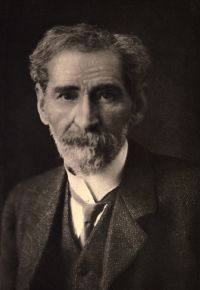
W. H. Hudson

W. H. Hudson

Summary

Portrait of W. H. Hudson W. H. Hudson A Little Boy Lost

Then he slowly fell backwards out upon the sea, and falling upon the sea caused so mighty a wave that it went high over the black rock and washed the face of the cliff, sweeping Martin back among the rocks.
When the great wave retired, and Martin, half-choked with water and half-dazed, struggled on to his feet, he saw that it was night, and a cloudy, black sky was above, and the black sea beneath him. He had not seen the light fade, and had perhaps fallen asleep and seen and talked with that old sea monster in a dream.
Source: Gutenberg

Portrait of W. H. Hudson W. H. Hudson A Little Boy Lost

Poor Martin could do nothing but gaze up at the little he could see of the sky in that close, black place, until his neck ached with the strain; but at last, to make him hope, he heard a sound—the now familiar long shrill cry of the wild man. Then, as it came nearer, the sound of tramping hoofs and neighing of the horses was heard, and the cries and hoof-beats grew louder and then fainter in turns, and sounded now on this side, now on that, and he knew that they were looking for him. "I'm here, I'm here," he cried; "oh, dear horses, come and take me away!"
Source: Gutenberg

Portrait of W. H. Hudson W. H. Hudson A Little Boy Lost

Then Martin got up and stared all round him at the wide landscape, and everything looked strange and dim and sorrowful. A shadow passed over the lake, and a murmur came up out of the rushes that was like a voice saying something that he could not understand. A great cry of pain rose from his heart and died to a whisper on his lips; he was awed into silence. Sinking down upon the grass again, he hid his face against the rosy-breasted bird and began to sob. How warm the dead bird felt against his cheek—oh, so warm—and it could not live and fly about with the others.
Source: Gutenberg

Get perspective with Kwize: daily news enlightened by great literature