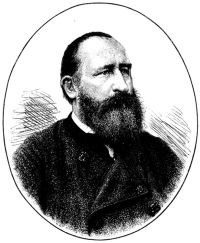
Philip Henry Gosse

Biographical details

Portrait of Philip Henry Gosse Philip Henry Gosse The Romance of Natural History…

Not he: he knows his powers better. He gives it one embrace; one strong hug; as if to test its thickness and hold upon the earth. Now he is digging away below, scooping out the soft soil from between the roots,—and it is marvellous to note how rapidly he lays them bare with those great shovel-like claws of his. Now he rears himself again; straddles wide on his hind feet, fixing the mighty claws deep in the ground; plants himself firmly on his huge tail, as on the third foot of a tripod, and once more grasps the tree.
Source: Gutenberg

Portrait of Philip Henry Gosse Philip Henry Gosse The birds of Jamaica (1847)

I have been informed by those who have noticed the bird on the wing, that although the Macaws are never seen but flying extremely high, their great size, and their splendid length of tail, brilliant with intense scarlet, and blue and yellow, strikingly attract attention, if their harsh scream, heard in the hushed mountain solitudes, does not betray them. They fly from one ridge to another, journeying in pairs, and have been followed by the eye till they have alighted on the loftiest of the forest trees, in their chosen resting places.
Source: Gutenberg

Portrait of Philip Henry Gosse Philip Henry Gosse Natural History, Fishes (1851)

Who can penetrate into the depths of ocean to trace the arrowy course of the mailed and glittering beings that shoot along like animated beams of light? Who can follow them to their rocky beds and coral caverns? The wandering mariner sees with interested curiosity the Flying-fish leap in flocks from the water, and the eager Bonito rushing after them in swift pursuit; but who can tell what the Flying-fish is doing when not pursued, or how the Bonito is engaged when the prey is not before him?
Source: Wikisource

Get perspective with Kwize: daily news enlightened by great literature